
What Your Executive Program Certificate Actually Means on Your Resume: An HR Perspective

Share :

You finish the course. You update your LinkedIn profile. You add the certificate to your resume. And then a quiet question comes up. Does this actually matter to the person reading my application? The short answer is yes. But only if you understand what it tells a recruiter and how to present it properly. Here is a clear look at executive programme certificates through the eyes of HR leaders, talent managers, and hiring bosses. What do they actually think when they see one? And how do you make sure your investment works in your favor?
What HR Notices First
When an experienced recruiter sees an executive certificate on a resume, they do not just read the title and move on. They look at the full picture around it. They look at where you were in your career when you took the course. They check which school ran the programme. Most importantly, they look at what happened to your role afterwards. The certificate is just one data point. The story around it is what matters.
A certificate from a respected business school, taken at a logical point in your career and followed by a promotion, shows deliberate effort. It tells the reviewer that you spotted a gap in your skills, fixed it, and put the new knowledge to work. On the other hand, the same certificate sitting on a resume with zero career movement raises a simple question: Did this training actually change anything?
Why the School Name Matters
HR teams know how much the executive education market has grown over the last decade. They also know that quality varies wildly across different platforms and providers. Because of this, the institution's name is the very first filter they use.
Certificates from top schools like IIM Bangalore, IIM Calcutta, IIM Lucknow, or ISB give you instant credibility. The recruiter already knows these schools have high standards. They do not need to do any extra research to verify the course quality. A course from an unknown provider without a strong university partner takes more effort to prove. It will not get you rejected automatically, but it will not open doors the way a top-tier school name does. This is not about snobbery. It is about simple trust. Recruiters rely on known brand names because those schools consistently deliver solid results.
This isn't about being picky. It is just about trust. Recruiters choose well-known schools because those institutions have a proven track record of producing great talent.
What a Certificate Cannot Do
Good HR professionals are very practical about what an executive certificate is and what it is not. Let us have a look at those first.
First, it is not an MBA. Hiring managers know the difference in depth and time commitment. If a candidate tries to pass off a short executive course as a full degree, they lose trust instantly.
Second, a certificate does not guarantee a promotion or a higher salary on its own. It proves you spent time learning. It does not prove you can handle a bigger team or manage a larger budget. Your daily track record still carries the most weight there.
Finally, a certificate cannot hide a weak resume. Adding a prestigious course to an underperforming work history only highlights the contrast.
What a good certificate does do is give a solid resume an extra edge. It shows initiative. In a close contest between two similar applicants, it is often the detail that pushes you into the interview pile.
What HR leaders Check Around the Certificate
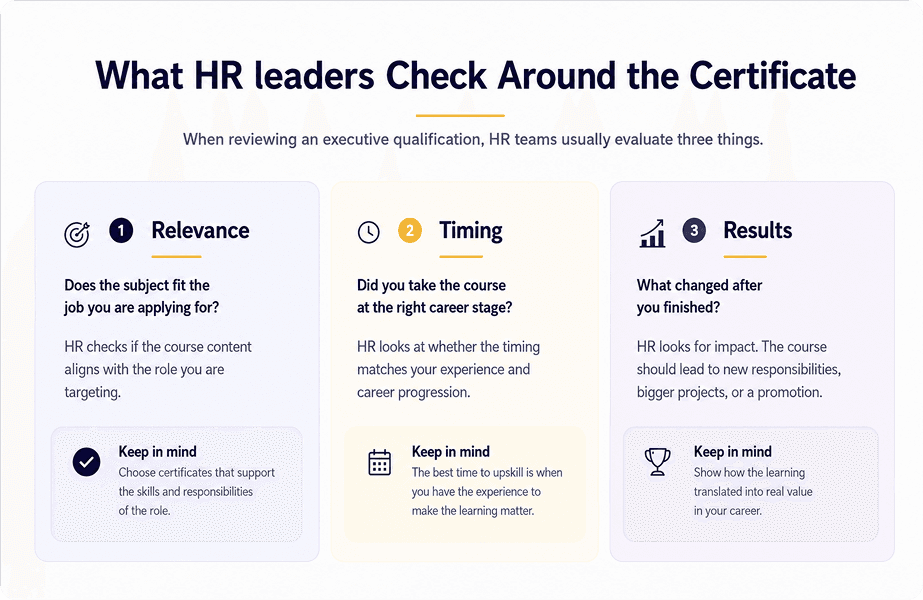
When reviewing an executive qualification, HR teams usually evaluate three specific things:
Relevance: Does the subject fit the job you are applying for? A strategic management course makes total sense if you are stepping into a general manager role. That same course on a technical specialist's resume looks out of place.
Timing: Did you take the course at the right career stage? Doing a senior leadership course with just two years of work experience looks like credential chasing. Doing that same course after eight or ten years shows you are preparing for the next step.
Results: What changed after you finished? If two years have passed and your responsibilities are identical, the training probably did not stick. If the course led to bigger projects, new tasks, or a promotion, it shows you turned learning into real value.
How to List the Certificate on Your Resume
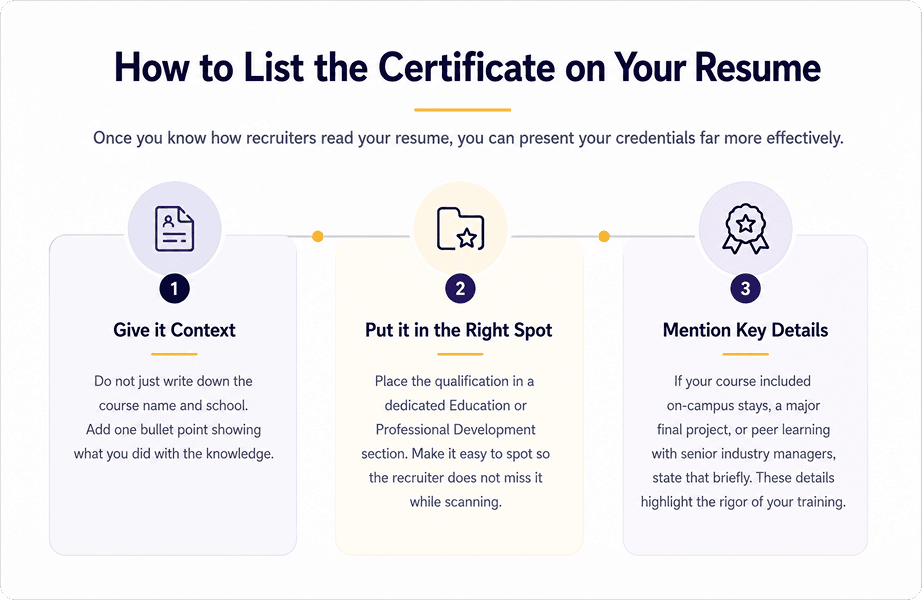
Once you know how recruiters read your resume, you can present your credentials far more effectively.
1. Give it Context
Do not just write down the course name and school. Add one bullet point showing what you did with the knowledge.
2. Put it in the Right Spot
Place the qualification in a dedicated Education or Professional Development section. Make it easy to spot so the recruiter does not miss it while scanning.
3. Mention Key Details
If your course included on-campus stays, a major final project, or peer learning with senior industry managers, state that briefly. These details highlight the rigor of your training.
Addressing Common HR Objections
Recruiters often hold subtle doubts when evaluating candidates with executive certificates. Here is how to counter them directly on your profile:
Common HR Objection | What the Recruiter Thinks | How You Address It on Your Resume |
Is this just a bought credential? | They worry you paid for a certificate without doing real work. | Mention capstone projects, grades, or hands-on assignments. |
Can they actually apply this? | They doubt if textbook knowledge translates to daily tasks. | Pair the course listing with a real-world achievement or metric. |
Are they trying to fake an MBA? | They suspect you are overstating a short executive course. | Clearly label it under "Executive Education" or "Certifications." |
The Real Signal Behind the Credential
When you ask HR leaders what executive certificates really tell them, their answer is usually simple. The credential itself matters, but what it reveals about you matters more. A professional who spots a gap in their knowledge, invests their own time and money to fix it, and completes a tough course at a good school sends a clear message. It shows you have self-awareness. It shows you take your career seriously. And it proves you do not wait for a manager to train you before you improve yourself.
Think of a certificate as an amplifier for your career. It takes your existing experience and gives recruiters a clear reason to shortlist you for leadership roles.
Looking to find an executive course that fits your career goals? Use Echomind Explorer to compare programmes from top institutions like the IIMs and ISB side by side, with full clarity on fees and formats.
Share :