
The Complete Guide to Executive Certification in India

Share :
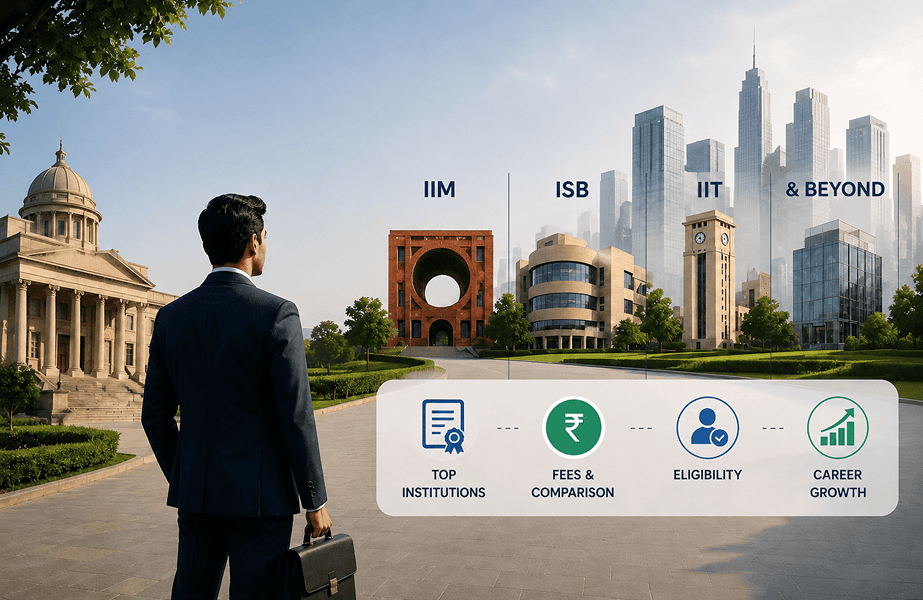
The Complete Guide to Executive Certification in India
There is an invisible ceiling in the Indian corporate landscape that every working professional hits between their 7th and 10th year of service. Up until this point, your career trajectory is largely determined by your technical execution, how exceptionally you write code, audit financial statements, manage specific supply chains, or close mid-market sales accounts. Hard work translates predictably into great appraisals and incremental title upgrades.
Then, the rules change.
If you have spent the past seven to ten years building domain expertise, the problem is rarely your competence. The problem is that technical depth, past a certain point, stops translating into career velocity. The market already knows you can do the job. What it is now asking and what your organisation is evaluating is whether you can lead it.
This is the mid-career growth plateau. It affects engineers, finance professionals, marketing heads, operations managers, and product leaders equally. And in 2026, as AI reshapes job functions across every sector, the plateau is arriving earlier and hitting harder.
For a growing number of professionals, the response is not to quit and pursue a full-time MBA, a two-year commitment that costs both income and momentum. Instead, they are turning to executive certifications: structured, specialised programmes designed for people who are already accomplished, who cannot afford to step away from their careers, and who need tangible, credentialled growth without the disruption.
This guide explains everything you need to know what executive certifications actually are, how they compare to degrees and MBAs, which institutions and domains matter most in India, and how to decide whether one is right for you.
Executive Summary
If you are pressed for time, here is the essential baseline for mid-to-senior professionals exploring the executive education ecosystem in India this year:
Executive certifications are short-to-medium duration programmes (3–18 months) designed for working professionals with meaningful experience.
They are offered by premier institutions including IIM, ISB, IIT, XLRI, MDI, Harvard, MIT, Stanford, Oxford, and INSEAD.
They differ from MBAs in duration, cost, focus, and flexibility, but can deliver comparable career outcomes in specific contexts.
You can do most programmes while working full-time.
Fees typically range from ₹1 lakh to ₹20 lakhs+ depending on institution, duration, and format.
The right programme accelerates leadership transitions, signals strategic readiness, and opens access to elite professional networks.
What is Executive Certification?
To understand what an executive certification actually is, you must first strip away the marketing jargon often used by ed-tech aggregators and look at how these programs are structurally and legally defined.
Executive certification is a form of structured, post-experience professional education. Unlike undergraduate degrees or traditional postgraduate programmes, executive certifications are built around the assumption that participants already have professional experience and that the curriculum must therefore engage with that experience, not precede it.
These executive certification courses are typically designed for professionals with five years or more of work experience, covering domains such as general management, digital transformation, AI leadership, business analytics, finance, product management, and sustainability. They are delivered by business schools, technical institutes, and in some cases in partnership with global institutions.
The hybrid structure is central to their appeal. Most executive certification programmes in India today combine asynchronous online modules. Which you complete at your own pace, with live virtual sessions, faculty-led masterclasses, and periodic campus immersions. This format allows professionals to remain employed and productive whilst still engaging with rigorous academic content and a high-quality peer group.
Unlike traditional university education, which focuses heavily on foundational theories, executive certifications operate on a plug-and-play architecture. They assume you already understand the mechanics of daily business execution. Therefore, the curriculum focuses squarely on macro enterprise strategy, algorithmic decision-making, digital cross-functional agility, and boardroom impact.

The Core Target: Who Are They Designed For?
These programs are not entry-level upskilling tracks. They are meticulously structured for a distinct demographic:
Experienced Specialists: Senior software architects, lead data scientists, senior financial analysts, or operations managers who have excelled in technical delivery but lack the broader strategic toolkit required for a VP or CXO track.
Time-Poor Executives: Corporate leaders who cannot afford to take a career sabbatical, risk their current compounding salary equity, or disconnect from their market presence for 12 to 24 months.
Domain Pivoters: Mid-career managers looking to execute a sharp transition into high-growth verticals like AI Product Management, Digital Transformation Governance, or Business Analytics.
The Delivery Framework: The Hybrid Architecture
The primary reason executive certifications have exploded in popularity across the Indian corporate ecosystem is their delivery model. They are constructed around the strict time constraints of a professional working 50+ hours a week.
Modern premium executive programs leverage a highly structured hybrid (blended) learning architecture, which typically breaks down into three distinct operational pillars:
Live Online Weekend Seminars: Instead of passive, pre-recorded lectures, core modules are delivered via interactive, live-streaming sessions on Saturdays or Sundays. These are led directly by senior institutional faculty from premier business schools or industry practitioners, focusing on real-time Socratic debate and strategic breakdown of global corporate events.
Asynchronous Case Study Analysis: Mid-week learning is highly flexible, utilizing advanced Learning Management Systems (LMS). Executives review global case studies (e.g., Harvard Business Publishing materials), collaborate on peer group projects, and run real-world simulations on their own schedules.
Mandatory On-Campus Immersions: This is the crown jewel of the executive format. Most top-tier programs include one to two mandatory residential blocks (ranging from 3 to 7 days) at the institution's physical campus (such as the IIM or ISB campuses). During these immersions, you undergo intense, face-to-face boardroom simulations, present comprehensive capstone projects, and build high-octane personal networks over formal executive dinners.

Certificate vs. Diploma vs. Executive Degree
One of the most expensive mistakes a working professional can make in India is confusing institutional terminology. Under the strict regulatory frameworks governed by the University Grants Commission (UGC) and the All India Council for Technical Education (AICTE), titles carry precise legal weight.
Before deploying your personal or corporate capital, you must understand where a program sits on the credential spectrum:
Evaluative Metric | Executive Certification | Executive Diploma (PGDM) | Executive MBA / Degree (EMBA) |
Primary Definition | A non-statutory, employer-recognised professional upskilling credential. | A formal, postgraduate program focusing heavily on practical management delivery. | A full statutory degree awarded by a recognised university under central or state acts. |
Typical Duration | 3 to 12 months (highly modular). | 12 to 18 months. | 15 to 24 months (intensive). |
Regulatory Status (UGC / AICTE) | Exempt / Non-Statutory. Does not require formal regulator approval, as it is classified as continuing institutional education rather than an academic degree. | Requires AICTE / UGC approval to be legally classified as a formal standalone diploma. | Must strictly comply with UGC Section 22 or the IIM Act 2017 to carry formal degree nomenclature. |
Academic Pathways Granted | None. Does not qualify the candidate for UGC-NET, central government Group A academic tracks, or PhD tracks. | Dependent on Association of Indian Universities (AIU) equivalence mapping for higher academic tracks. | Fully qualifies the holder for global and domestic doctoral research (PhD) and formal academic roles. |
Corporate & Industry Recognition | Exceptional. Highly valued by private enterprises, global capability centres, and tech conglomerates for immediate, functional skill validation. | High. Recognised across corporate domains as a robust, mid-career management foundation. | Elite. Universally recognised across both private public sectors globally as a premium master's qualification. |
Admissions Architecture | Profile-based evaluation focusing heavily on your professional track record, leadership scale, and years of experience. | Often requires profile review accompanied by mid-level internal corporate evaluations. | Requires competitive entrance test evaluation (e.g., GMAT, CAT, or institutional aptitude assessments). |
Executive Certification vs Traditional Degrees & MBAs
Very often the first question professionals ask is “Is executive certification worth it?” and it deserves a clear answer rather than a hedged one.
Executive Certification vs Degree: The core difference
A traditional degree is a generalist credential built for the beginning of a career. It signals foundational academic achievement and broad employability. An executive certification, by contrast, is a specialist credential built for a specific career moment, when a professional needs to deepen leadership capability, pivot into a new domain, or demonstrate strategic readiness for a senior role.
The learning approach differs accordingly. Degree programmes are structured around faculty-led theory, examinations, and academic assessment. Executive certifications are structured around applied learning case studies drawn from real organisations, peer discussions among experienced professionals, and projects grounded in your current work context. The classroom is not hypothetical. It is populated with people who bring ten years of lived professional experience to every discussion.
Executive Certificate vs MBA worth it: When does an Executive MBA make more sense?
An Executive MBA makes sense when a professional needs the full breadth of general management education; finance, strategy, operations, marketing, organisational behaviour and has the time and budget to commit to an intensive programme over 12 to 24 months. IIM-level EMBA programmes typically require five to fifteen years of experience and consistently show the highest salary uplift for senior professionals.
A specialised executive certification, on the other hand, makes sense when the professional already has management foundations and needs targeted depth, in AI strategy, digital transformation, product leadership, or financial management. The specialisation delivers faster, more focused returns.
The opportunity cost question
Leaving a stable income for a full-time MBA involves more than tuition fees. There is the foregone salary during the programme (often ₹15–30 lakhs over two years at mid-senior levels), the social cost of career interruption, and the ramp-up time after re-entry. For professionals in their mid-thirties or forties, this calculus often tips decisively in favour of programmes that allow continued employment. For self-funded professionals, the part-time or online management programme almost always offers better financial ROI, low fees, income continues throughout, and no relocation costs.
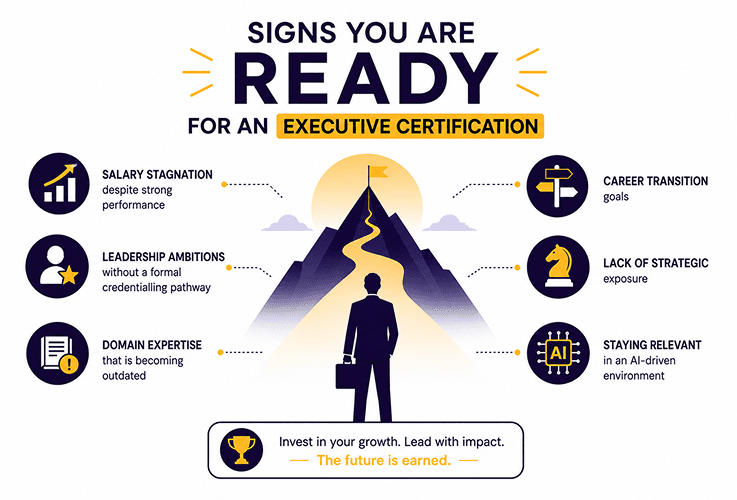
Signs You Are Ready for an Executive Certification
Not every professional is at the right stage for an executive programme. The following are reliable indicators that the timing is right:
Salary stagnation despite strong performance
If your last two or three appraisal cycles have brought incremental increases without a step-change in compensation or responsibility, it is a signal that your current positioning has a ceiling.
Leadership ambitions without a formal credentialling pathway
Many professionals are told they have potential for senior roles but lack the strategic vocabulary, cross-functional exposure, or formal credentials that organisations use to evaluate leadership candidates.
Domain expertise that is becoming outdated
AI, automation, and digital transformation are restructuring entire industries. A finance professional who does not understand data-driven decision-making, or a marketing leader unfamiliar with AI-driven customer intelligence, faces growing irrelevance, regardless of their years of experience.
Career transition goals
If you are looking to move from a technical role into management, from operations into strategy, or from one industry to another, an executive certification provides both the knowledge and the credentialled legitimacy to make that case to a new employer or recruiter.
Lack of strategic exposure
Mid-level professionals often develop deep functional expertise but limited exposure to enterprise-level strategy, P&L responsibility, or C-suite decision-making frameworks. Executive programmes are specifically designed to bridge this gap.
Staying relevant in an AI-driven environment.
AI professionals in India in 2026 are seeing 30–60% salary growth compared to traditional roles. And the premium on professionals who can lead AI adoption, not just understand it technically, is rising sharply.
Why Now? The Strategic Benefits of Executive Certification for Career Growth
When you enroll in an executive certification course at a premier institution, you are not paying for content. Textbook theories are readily available online. Instead, you are acquiring an institutional asset designed to alter your professional trajectory.
Signaling Leadership Readiness
In modern corporate environments, promotions are rarely backward-looking rewards; they are forward-looking bets. Graduating from an intensive executive program from an institute like an IIM or ISB functions as a high-visibility corporate signal. It tells internal HR leaders and external executive search firms that you possess the professional initiative and strategic capability required to handle enterprise risk.
High-level of Peer Networking
The real value of premium executive classrooms is found in peer interaction. On any given Saturday, your project team could consist of a Regional Vice President from a major bank, a Senior Director from a Global Capability Centre (GCC), and a high-growth startup founder. This environment completely reframes your professional perspective, replacing lower-level execution focus with high-level corporate benchmarking.
Institutional Alumni Leverage
Completing a comprehensive executive credential at premier business schools frequently unlocks varying degrees of institutional alumni status. This grants you lifetime access to exclusive portals, regional chapters, and closed networking groups. When properly showcased on LinkedIn, this pedigree immediately differentiates your profile, converting cold recruiter outreach into warm, peer-led executive opportunities.
The Applied Architecture: "Learn on Saturday, Implement on Monday"
Traditional degrees operate on delayed utility, requiring you to pause your life to absorb theory for two years. Executive certifications run in parallel with your career. If you dissect a complex corporate restructuring case study or an AI-driven operational efficiency model over the weekend, you can directly apply those exact frameworks to your active workplace initiatives on Monday morning.
Can I do executive certification while working full-time?
Yes, and this is precisely what these programmes are designed for. The hybrid delivery model (asynchronous modules for self-paced learning, live weekend sessions, and periodic campus immersions of two to four days) is specifically structured to accommodate senior professionals with demanding schedules. The time commitment typically ranges from six to fifteen hours per week, depending on the programme. What it requires is not unlimited time, but consistent time management and genuine commitment to showing up for live sessions and peer learning.
Most In-Demand Executive Certification Domains in 2026
The following categories represent the fastest-growing areas of executive education in India today, driven by a combination of industry demand, technological disruption, and career transition patterns:
AI Leadership and Strategy
The most sought-after executive certification category in 2026. Designed not for engineers who build AI, but for business leaders who must deploy, govern, and derive value from it.
Product Management
One of the highest-salary growth domains in India's technology and startup ecosystem. Executive programmes here focus on product strategy, roadmap ownership, stakeholder management, and data-driven product decisions.
Digital Transformation
A priority for organisations across manufacturing, financial services, healthcare, and retail. Executive programmes in this domain equip functional leaders to drive, rather than merely respond to, enterprise-wide digital change.
Business Analytics and Data-Driven Decision Making
The ability to interpret data, build analytical frameworks, and drive decisions from evidence rather than intuition has become table-stakes for senior management in most industries.
General Management
For professionals transitioning from functional roles to business unit leadership, general management programmes provide the P&L exposure, cross-functional frameworks, and leadership models that organisations expect of general managers.
Finance Leadership
Advanced finance certifications for professionals moving from technical financial roles into CFO-track or strategic finance functions, covering topics such as financial strategy, M&A, and investor relations.
Cybersecurity Leadership
As digital infrastructure becomes critical, organisations are demanding senior leaders who can govern security at a strategic level, not just manage it operationally.
Marketing Leadership
Brand strategy, digital marketing, performance marketing, and consumer behaviour programmes designed for senior marketing professionals navigating the post-AI, omnichannel landscape.
Sustainability and ESG Leadership
A rapidly growing area as regulatory requirements and investor expectations around environmental, social, and governance practices reshape corporate strategy across sectors.

Top Institutions Offering Executive Certifications in India and Globally
Institutional brand matters in executive education, not as a vanity metric, but because it determines the quality of the faculty, the calibre of the peer cohort, the strength of the alumni network, and how recruiters and organisations perceive your credential.
India's Premier Institutions
IIM (Indian Institutes of Management) - The gold standard for management education in India. IIM Ahmedabad, IIM Bangalore, IIM Calcutta, IIM Lucknow, and IIM Kozhikode offer executive programmes that cater to mid-career professionals.
ISB (Indian School of Business) - ISB is distinguished by its blended learning model, international curriculum, and multicultural peer group across its campuses in Hyderabad and Mohali.
IIT (Indian Institutes of Technology) - IIT Bombay, IIT Delhi, IIT Madras, and IIT Kharagpur offer executive programmes in technology leadership, analytics, AI, and engineering management, drawing on their research depth and technical faculty.
XLRI (Xavier School of Management), Jamshedpur - Known for strong HR leadership programmes and general management certifications, with AACSB accreditation and twenty-five international partner institutions.
MDI (Management Development Institute), Gurugram - A strong choice for professionals in consulting, FMCG, and public sector, with well-regarded general management and leadership programmes.
The Global Elite (International Collaborations)
Harvard Business School - HBX and Harvard Online offer executive certificate programmes in management, leadership, strategy, and finance. Recognised globally and valued by multinationals operating in India.
MIT Sloan - Known for its rigorous, analytically-oriented executive education programmes in leadership, technology strategy, and business management.
Stanford Graduate School of Business - Offers executive programmes in innovation, strategy, and organisational leadership with strong applicability for professionals in technology and entrepreneurship.
Oxford Saïd Business School - Oxford's executive programmes have growing recognition in India, particularly in strategy, finance, and leadership.
INSEAD - Globally renowned for general management and leadership programmes with an exceptionally diverse peer cohort and strong European and Asian network value.
Eligibility & Admission Process
Premium executive programs do not use standardised academic entry tests like the CAT or GMAT as their primary gatekeepers. Because these programs depend entirely on peer-to-peer knowledge exchange, the admissions process functions more like a corporate selection panel.
Experience-Based Tiering
Mid-Management Tracks (5+ Years of Experience): Programs focus heavily on functional leadership, project management analytics, and tactical team management.
Senior Leadership Frameworks (10 to 15+ Years of Experience): Reserved for elite general management programs, corporate governance modules, and CXO preparation tracks.
Profile-Based Evaluation
Admissions committees assess your professional trajectory rather than your undergraduate grades from a decade prior. They look closely at your current designation, the scale of your budgetary or team-management responsibilities, cross-functional achievements, and your stated career objectives.
The primary requirement is demonstrating that you can contribute meaningful, real-world insights to classroom case discussions.
Financial Planning: Executive Certification Course Fees and Calculating True ROI
Executive certification fees in India span a wide range depending on institution tier, programme duration, and whether the programme involves a global collaboration.
Domestic Tier-1 programmes (IIM, ISB, IIT, XLRI) typically range from ₹3 lakhs to ₹12 lakhs for certificate and diploma programmes. Full executive MBA or PGPX programmes at the same institutions can range from ₹15 lakhs to ₹40 lakhs.
Global collaboration programmes joint programmes between Indian and international institutions generally range from ₹5 lakhs to ₹20 lakhs or more. This depends on the partner institution and the extent of in-person international components.
Calculating true ROI
The fee is only one side of the equation. Consider:
Salary growth
Executive programme graduates typically experience a 30–50% increase in salary after completing their programme. Even a conservative 20–30% salary increment at a mid-senior level income represents a significant return over a five-year horizon.
Leadership transitions
The career outcome most executives actually seek is not a marginal salary increase but a fundamental change in role level. From senior manager to director, from director to VP, or from functional lead to general manager. The financial implications of that transition increase over a decade or more.
Career pivot value
If the certification enables a move into a significantly higher-paying domain or industry, the ROI calculation changes dramatically.
Employer sponsorship
Many large Indian and multinational corporations partially or fully fund executive education for high-potential employees. Before self-funding, investigate whether your organisation has a structured sponsorship policy. Programmes that are clearly tied to your current or near-future role responsibilities are often the most fundable.
Executive Certification for Career Transitions
One of the greatest challenges for a seasoned professional is breaking out of a functional silo. If you have spent several years in technical operations, the market struggles to see you as a strategic business leader. Executive certifications act as a bridge across these corporate divides. And organisations are on the lookout for skill based candidates rather than degree based ones. Because with the rise of AI, automation, and digital tools, most roles today require a mix of skills that cut across functions.
By providing an authoritative stamp from an elite business school, these programs validate your transition from functional execution to macro enterprise strategy.
Whether you are aiming for an industry pivot (e.g., moving from traditional manufacturing to a digital platform business) or a functional shift (e.g., transitioning from software development to product management), the curriculum provides the foundational vocabulary and executive framework required to command authority from day one.
Why Recruiters Value Executive Certifications Differently Than Traditional Degrees
The modern corporate talent acquisition landscape has undergone a major shift. While a foundational university degree proves your early-life academic capability, it quickly becomes static in an economy shaped by rapid technological change.
In 2026, premium enterprise recruiters, Global Capability Centres, and forward-thinking corporations value executive certifications for several distinct reasons:
Proof of Active Adaptability: Completing a rigorous, high-level curriculum while balancing a full-time corporate role demonstrates exceptional drive, time management, and professional resilience.
Up-to-Date Industry Relevance: Traditional university degrees take years to update their official curricula through formal academic boards. Executive certificates, by contrast, are agile; they integrate real-time market shifts, such as AI governance and advanced predictive analytics, directly into their active modules.
Verified Strategic Intent: When an experienced candidate showcases a specialised credential from an institution like ISB or an IIM on their resume, it signals clear intent. It shows that the professional has proactively moved past comfortable day-to-day execution to master enterprise-level decision-making.
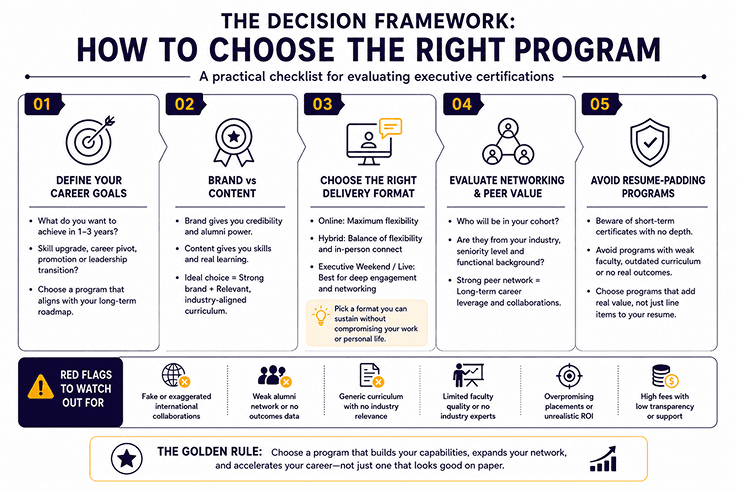
Here is a detailed infographic to help you understand how to choose executive certification.
Red Flags to Watch Out for Before Enrolling
The executive education market in India is large and growing, and not every programme operating within it is worth your investment. Specific warning signs include:
Weak or anonymous alumni ecosystems
If a programme cannot point you to accessible, identifiable alumni willing to speak about their experience, that absence is telling.
Generic curriculum
If the syllabus looks identical to five other programmes in the same category and there is no visible intellectual distinctiveness, it is likely a content-light offering.
Misleading placement promises
Legitimate executive programmes are enrolled by professionals with existing careers. They do not make blanket placement guarantees. Programmes that promise specific salary outcomes or guaranteed job placements should be scrutinised carefully.
Fabricated international collaborations
Some programmes present international partnerships that amount to a name licence rather than a meaningful academic relationship. Look for programmes where international faculty actually teach, where peer learning crosses geographies, or where campus components take place at the partner institution.
Low-quality peer learning environment
Ask about cohort eligibility requirements and average experience levels. A programme that admits anyone regardless of professional background will not deliver the peer learning value that justifies the fee.
Online vs. Offline vs. Hybrid: Which Mode Is Right for You?
Choosing the right format requires balancing your personal learning preferences with your weekly corporate schedule:
Learning Mode | Operational Structure | Core Advantages | Key Trade-Offs |
Purely Online | Asynchronous modules combined with occasional live virtual check-ins. | Maximum schedule flexibility; lower overall financial investment. | Limited personal networking; requires high individual accountability to prevent completion drop-off. |
Traditional Offline | Fixed physical weekend classes at a local city centre or regional university branch. | Immediate, consistent face-to-face interaction and routine learning habits. | Demands strict geographical proximity; can be difficult to sustain during intense business travel. |
The Hybrid Model | Regular live virtual weekend sessions backed by mandatory physical campus residencies. | The Optimal Balance. Combines weekly schedule flexibility with high-impact, in-person campus networking. | Requires planning dedicated leaves from your employer for campus residency blocks. |
The Future of Executive Certification in India
The traditional model of education as a single, front-loaded investment; one degree, one institution, one credential for a forty-year career, is quietly losing ground. It is being replaced by a model of continuous, modular professional development, where professionals return to structured learning at multiple inflection points across their careers.
This shift is driven by the pace of change in the professional environment. In 2026, the capabilities that make a senior professional effective are shifting faster than at any point in the past three decades. AI is restructuring job functions. Regulatory environments are evolving. New industries are emerging while established ones are being reorganised. A credential earned at twenty-five cannot carry a career through sixty-five without some deliberate renewal along the way.
The rise of AI-driven personalised learning, modular micro-credentials, and stackable certification pathways means that executive education is increasingly accessible, in format, in cost, and in time commitment. The structural direction of travel is towards more frequent, more targeted professional development, rather than single high-stakes credentials consumed at wide intervals.
Conclusion: Investing in Your Professional Future
Staying professionally static in 2026 is not a neutral choice. It is a choice to compete with a diminishing asset base against a professional market that is actively refreshing its skills. The careers that thrive across the next decade will belong to professionals who treat growth as an ongoing practice, not a one-time event.
Executive certification for working professionals, from the right institution, in the right domain, at the right career moment, is one of the highest-leverage investments.
“It is not about the certificate. It is about what the programme builds: strategic capability, leadership credibility, peer networks, and the confidence to operate at the next level.”
The decision requires clarity about where you want to go, honesty about the gaps that stand between here and there, and the discipline to commit to a programme that genuinely bridges them.
At Echomind, we help working professionals navigate exactly this decision, identifying the programmes that align with their specific career goals, and open the doors to India's best executive education.
Ready to find the right executive certification for your career stage? Login to Echomind Explorer today!
Share :
Frequently asked questions (FAQs)
For any unanswered questions, reach out to our support team via contact us page or email. We'll respond with-in a day to assist you.