
The ROI of Automated Operations in Higher Ed and Bridging the Executive Skill Gap

Share :

1. Introduction to the growing disconnect in Higher Education
The global economy is currently undergoing a seismic shift. Rapid industrial changes and the rise of AI have rendered traditional business models obsolete. New technologies, shifting market dynamics, and changing leadership expectations are constantly redefining what it means to stay relevant. Consequently, the professional landscape now demands a state of constant evolution. Continuous upskilling is no longer a luxury for the ambitious population; in fact, it has become an essential requirement for survival.
1.1 The Expanding Executive Skill Gap
The pace at which industries are evolving today is no longer incremental, it’s exponential. New technologies, shifting market dynamics, and changing leadership expectations are constantly redefining what it means to stay relevant. For working professionals and leaders, this has created a widening gap between existing capabilities and emerging skill requirements. What was once considered expertise can quickly become outdated.
As a result, learning is no longer a phase, it has become a continuous necessity.
1.2 Rising Demand for Executive Education
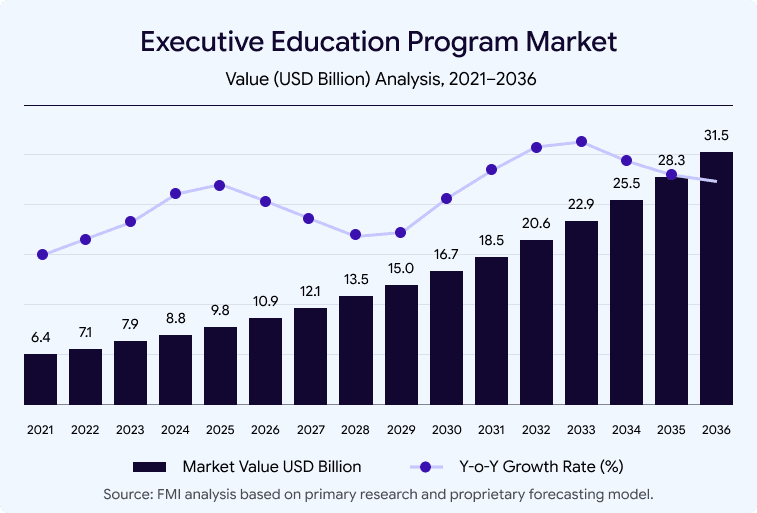
This shift has led to a surge in demand for executive and professional education. Today’s learners are not just looking for knowledge; they seek programs that are flexible, outcome-driven, and aligned with real-world challenges. At the same time, education institutions face immense pressure to deliver these services at a massive scale. The race to provide relevant, high-quality executive coaching has never been more intense.
The expectation is clear: faster, more adaptive, and more impactful education.
1.3 The Core Tension
However, while demand continues to accelerate, the systems designed to deliver education have struggled to keep pace. Institutions are often working with fragmented tools, manual processes, and legacy workflows that limit their ability to respond quickly and efficiently.
This creates a fundamental disconnect, one where the need for agile, scalable learning is growing, but the operational foundations required to support it remain unchanged.
2. The Invisible Barrier: Operational Inefficiencies in Higher Ed
While the ambition for growth is present, many institutions face a hidden structural crisis. Outdated operational models act as an invisible barrier, preventing rapid adaptation. These inefficiencies drain resources and stifle the very innovation that universities aim to promote.
2.1 Fragmented Learning Ecosystems
Behind most learning experiences today lies a web of disconnected systems. Institutions often rely on multiple platforms to manage content, communication, assessments, and administration. While each tool serves a purpose, together they create fragmented workflows that are difficult to manage and even harder to scale. Information gets siloed, processes become repetitive, and coordination turns into a constant challenge.
What should feel like a cohesive learning journey instead becomes a patchwork of systems.
2.2 Administrative Overload
As the complexity increases, so does the burden on administrative and academic teams. They must manually manage faculty schedules, room bookings, and student communications across multiple platforms. This high-touch approach is not only prone to human error but also extremely difficult to scale.
Over time, this operational strain begins to impact both efficiency and quality.
2.3 Limited Agility in Program Delivery
In an environment where industry needs evolve rapidly, the ability to launch and adapt programs quickly is critical. However, traditional systems are inherently slow and rigid to respond to market changes. Launching a new executive course can take months of complex internal negotiations and technical set-up. This lack of agility makes it nearly impossible to adapt to sudden industry shifts.
The result is a system that struggles to keep pace with the very market it aims to serve.
2.4 Impact on Learner Experience
These operational gaps are not just internal challenges. They directly affect the learner experience. Students often experience inconsistent communication and a lack of continuity across different modules. And in a landscape where engagement is key, even small disruptions can lead to significant drop offs.
3. The Cost of Doing Nothing: Where Institutions Lose ROI
Inaction is often perceived as a safe choice, but in the context of Higher Education operations, it is a significant financial drain. Failing to modernise leads to a steady erosion of institutional value. These hidden costs manifest across four primary dimensions, each undermining the long-term sustainability of the academy.
3.1 Time Costs
The most immediate impact of operational decay is the loss of time. When processes rely heavily on manual coordination and disconnected systems, program rollouts are often delayed. What should take weeks can stretch into months, slowing down the institution’s ability to respond to market needs. Execution cycles become longer and less predictable, making it difficult to maintain momentum or deliver programs at the pace today’s learners expect.
3.2 Financial Costs
Operational inefficiencies do not just affect timelines. They also have a direct financial impact. Managing multiple systems, duplicating efforts, and relying on manual workflows increases operational overheads. At the same time, existing resources such as faculty time, administrative capacity, and infrastructure are not utilised to their full potential.
Over time, this leads to higher costs per program without a corresponding increase in value delivered.
3.3 Opportunity Costs
Perhaps the most significant loss is not always visible. When institutions are unable to launch programs quickly or scale effectively, they miss out on emerging market demand. New learning needs arise, but the inability to respond in time results in lost opportunities.
This also limits the growth of executive education offerings, restricting the institution’s ability to expand its reach and impact.
3.4 Experience Costs
The ripple effects extend to the learner experience as well. Modern executives have a low tolerance for administrative friction or technical glitches. If the "onboarding" or "enrolment" process is cumbersome, high-value learners are unlikely to return for future certifications. This leads to lower completion rates and poor word-of-mouth recommendations.
Over time, these experience costs manifest as a weakened brand and a shrinking alumni network, which are difficult to recover.
4. Reframing the Problem: From Content to Operations
To overcome the current stagnation in Higher Education, leadership must shift its focus. For too long, institutions have viewed academic quality as the sole driver of success. However, in the modern landscape, the method of delivery is just as critical as the information itself.
4.1 Why Content Alone Isn’t the Issue
Higher education institutions are not lacking in expertise or content. In fact, many already offer well designed, high quality programs led by experienced faculty and industry practitioners.
The intent is not the problem. The knowledge is not the problem.
In fact, many high-quality programmes fail simply because they are too difficult to access or navigate. Content remains the "product", but the product cannot reach the consumer if the supply chain is broken.
4.2 The Real Bottleneck: Execution
The gap between intent and impact often lies in execution.
Operational inefficiencies slow down every stage of program delivery, from planning and coordination to communication and learner engagement. What should be a seamless process becomes fragmented and effort intensive.
As a result, institutions are unable to fully realise the value of their own offerings. The challenge is not what is being taught, but how it is being delivered.
4.3 The Need for an Operational Backbone
To move forward, institutions need to rethink not just their programs, but the systems that power them. Modern education requires a robust, unified operational backbone. This means shifting away from fragmented tooling towards a unified, orchestrated approach to learning delivery.
Automation plays a critical role here. By reducing manual effort and streamlining workflows, it allows institutions to focus on what truly matters, delivering meaningful learning experiences.
5. Enter Echomind: Redefining Learning Operations
The systemic failures of traditional Higher Education require more than incremental updates; they demand a fundamental shift in infrastructure. Echomind enters this landscape not merely as a software provider, but as a comprehensive protagonist for institutional change. By positioning itself as the operational heart of the academy, Echomind transforms how universities interact with their data, their faculty, and their learners.
5.1 Echomind: The Unified Ecosystem
Echomind brings together the entire learning ecosystem into a single, cohesive command centre.
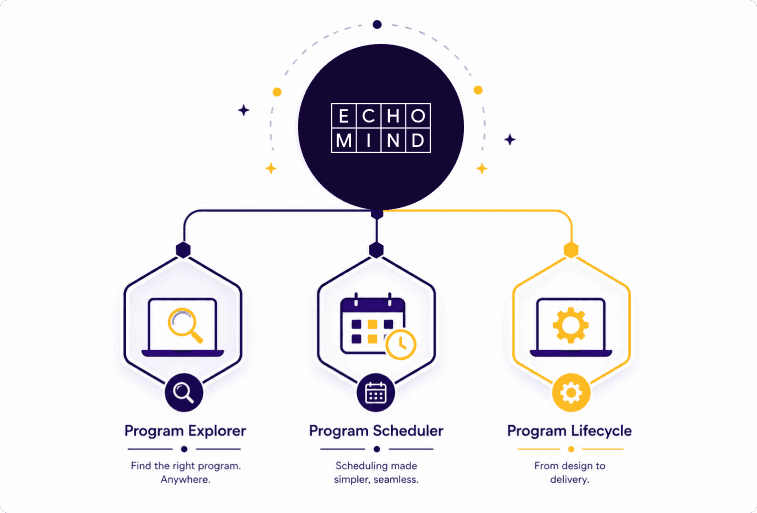
By integrating its Explorer, Scheduler, and Management modules, it connects what are typically separate layers of execution into one unified system. From program discovery and planning to delivery and oversight, every element operates in sync. This unified ecosystem brings together every stakeholder, learners, faculty, and administrators into a common digital space.
This alignment closes a critical gap that many institutions face, bridging the space between high level executive vision and on ground execution. What was once fragmented becomes coordinated, visible, and manageable.
5.2 Automation at the Core
At the heart of Echomind lies automation designed to simplify complexity. Workflows that once required continuous manual intervention are streamlined into structured, efficient processes. Routine tasks are handled seamlessly, reducing dependency on constant oversight and coordination.
This reduction in manual dependency does more than just prevent human error; it liberates administrative staff to focus on high-impact strategic initiatives. Automation ensures that the institution operates at peak efficiency, regardless of the complexity of the programme.
5.3 Seamless Coordination Across Stakeholders
Effective education requires perfect alignment between diverse groups. Echomind facilitates this by providing tailored interfaces for faculty, administrators, and learners, all powered by the same underlying data. Communication becomes more consistent, processes are easier to track, and responsibilities are clearly defined. Instead of navigating multiple tools and touchpoints, stakeholders operate within a unified environment.
The result is smoother coordination and a more cohesive learning experience.
5.4 Built for Scale and Flexibility
The modern educational market is characterised by rapid change and evolving learner needs. Echomind is engineered to support this volatility, allowing institutions to launch, modify, and scale executive programmes with unprecedented speed. Its modular architecture ensures that as the demand for new skills grows, the operational infrastructure expands to meet it.
This ability to scale without operational strain allows institutions to stay aligned with changing industry demands while maintaining quality and consistency.
6. How Echomind Drives ROI Through Automation
The transition to an automated operational model delivers measurable returns across the entire institutional spectrum. By treating operations as a strategic asset rather than a back-office necessity, Echomind enables universities to quantify success through four distinct dimensions of Return on Investment (ROI).
6.1 Operational ROI
Automation fundamentally changes how programs are executed and significantly accelerates the lifecycle of educational products, allowing for faster programme deployment. What once involved multiple layers of coordination can now move forward with clarity and speed. At the same time, manual workload is reduced across teams. Administrative effort decreases, coordination becomes more efficient, and execution cycles become more predictable.
The result is a smoother, faster operational rhythm. Also, this shift allows personnel to pivot from "firefighting" logistical crises to high-value student engagement and strategic planning.
6.2 Financial ROI
Improved operations naturally translate into stronger financial outcomes. Echomind’s "one platform" approach inherently lowers the overhead of running a programme. By reducing reliance on multiple tools and minimising repetitive manual processes, institutions can lower the overall cost associated with running each program. Resources that were previously underutilised can now be deployed more effectively.
This leads to better cost efficiency without compromising on the quality of delivery.
6.3 Experience ROI
In the competitive landscape of 2026, the quality of the journey is as important as the destination. Echomind drives experience ROI by fostering improved learner engagement through a frictionless interface. When students do not have to struggle with clunky enrolments or conflicting timetables, they remain focused on the curriculum. The platform ensures consistent learning journeys where every touchpoint, from initial inquiry to final certification, feels intentional and professional.
This seamlessness leads to higher completion rates and strengthens the lifelong relationship between the alumni and the institution.
6.4 Strategic ROI
Beyond immediate efficiencies, automation unlocks long term strategic value. Strategic ROI is found in the ability to facilitate scalable executive education without a linear increase in staff costs. Echomind allows a university to double its course offerings while maintaining a lean operational core. Programs can be launched and adapted more quickly in response to changing industry needs.
This agility allows institutions to stay relevant, competitive, and aligned with the evolving demands of modern learners.
7. Bridging the Executive Skill Gap at Scale
Addressing the global skill gap requires more than just high-quality content; it demands a delivery mechanism that matches the pace of modern industry. Echomind enables institutions to move beyond static, one-time courses toward a model of continuous, adaptive learning. By automating the operational journey, the platform ensures that the path to new expertise is clear, fast, and accessible.
7.1 From Static Programs to Continuous Learning
Traditional executive education has often been structured as a series of standalone programs. While effective in isolation, this approach struggles to keep up with the pace at which skills evolve.
Echomind enables a shift towards continuous learning by embedding automation into the way programs are delivered and updated. Instead of fixed timelines and rigid structures, institutions can create learning journeys that evolve over time. With operations running seamlessly in the background, programs can be refreshed, extended, and interconnected without added complexity. This allows learning to remain relevant long after a program begins.
7.2 Enabling Faster Skill Adoption
The time-to-market for new skills is a critical metric for both corporations and individuals. Echomind significantly reduces "time-to-learning" by removing the administrative friction that traditionally delays programme launches. Automated onboarding and instant resource provisioning allow learners to begin their journey the moment the need for a new skill is identified. This speed is essential for bridging the executive gap, where waiting months for a course to begin is often not an option. Efficiency in operations translates directly into agility in the workforce.
7.3 Supporting Lifelong Learning Ecosystems
As careers become more dynamic, the need for ongoing learning continues to grow. By enabling flexible and scalable program delivery, institutions can move towards building lifelong learning ecosystems. Echomind provides these lifelong learning ecosystems, where an individual's progress is tracked and supported over decades. Learners are no longer limited to one program or phase but can engage with multiple learning experiences over time.
This creates a more enduring relationship between institutions and learners, extending the value of education beyond a single course. Scaling this level of personal attention is only possible through the sophisticated automation Echomind provides.
7.4 Aligning Education with Industry Needs
Bridging the skill gap requires a tight feedback loop between the academic world and the corporate sector. Echomind’s operational agility allows institutions to pivot their offerings based on real-time market data and industry requirements. When a specific technical or leadership gap is identified, the platform facilitates the rapid orchestration of targeted training interventions. This alignment ensures that the education provided is always relevant, practical, and immediately applicable in the professional sphere.
Ultimately, Echomind empowers Higher Education to function as a responsive engine for global economic growth.

8. The Transformation: Before vs After Echomind
The impact of Echomind is best understood by observing the shift from a reactive, fragmented environment to a proactive, unified ecosystem. This transformation redefines how an institution functions, moving from administrative friction to operational flow.
8.1 Before
Prior to the integration of Echomind, the Higher Education experience was often defined by "siloed complexity." Learning delivery is supported by multiple disconnected tools, each handling a specific function but lacking cohesion.
Fragmented Systems: Staff must jump between multiple platforms for enrolments, scheduling, and student support. This leads to constant data duplication and a high risk of manual error.
Manual Processes: Coordination relies heavily on spreadsheets and endless email chains. Simple tasks, such as rescheduling a faculty member, become a multi-day administrative burden.
Limited Scalability: Because every new programme requires extensive manual set-up, the institution hit a natural ceiling. Growth is restricted by the physical capacity of the administrative team.
Reactive Learning Models: The institution only responds to industry shifts after they have happened. This lag makes it difficult to offer timely, relevant upskilling to the executive market.
8.2 After
With Echomind in place, operations shift from fragmented execution to unified orchestration. Technology handles the logistical weight, allowing the human element of education to thrive.
Unified Platform: Every stakeholder accesses a single source of truth. Data flows seamlessly between the Explorer and Scheduler modules, ensuring everyone has real-time, accurate information.
Automated Operations: Repetitive tasks disappear. Intelligent workflows handle complex scheduling variables and student communications instantly. This shift liberates staff for higher-value strategic work.
Scalable Programme Delivery: The institution can launch and manage dozens of new courses simultaneously without increasing administrative overhead. Scalability is built into the digital architecture of the campus.
Continuous, Adaptive Learning: The university becomes a proactive partner in the economy. It can identify skill gaps and deploy targeted learning interventions with unprecedented speed, keeping learners consistently ahead of the curve.

9. The Bigger Picture: The Future of Higher Education Operations
As we look toward the remainder of the decade, the boundary between traditional campus management and digital orchestration will vanish. The institutions that thrive will be those that stop viewing operations as a logistical burden and start seeing them as a competitive advantage.
9.1 From Institutions to Learning Ecosystems
Higher education is no longer confined to classrooms or standalone programs. It is evolving into a network of interconnected learning experiences that extend across time, roles, and geographies.
Echomind enables this shift by creating a unified operational layer where different stakeholders and learning journeys can coexist and interact seamlessly. What were once isolated offerings begin to function as part of a larger, continuous ecosystem.
This allows institutions to move beyond delivering programs and towards building enduring learning environments.
9.2 From Delivery to Orchestration
The role of institutions is also changing. For decades, the focus of university administration was simply the delivery of a static product. However, the future demands a shift toward active orchestration. This involves managing the entire learning experience as a dynamic, living system that adapts to the user in real-time. Orchestration requires a level of oversight that manual processes cannot provide.
Through Echomind’s unified command centre, leadership can monitor every operational pulse of the institution. They can predict bottlenecks before they occur and reallocate resources with a single click. The result is a more structured, efficient, and scalable approach to education delivery.
9.3 Why Operational Agility Will Define Success
As industries continue to evolve, the ability to adapt quickly will become a defining factor for educational institutions. Those that can respond to emerging skill demands, launch relevant programs, and scale without friction will lead the next phase of higher education. Those that cannot will struggle to keep pace.
Echomind equips institutions with this operational agility. By embedding automation and unification at the core of learning delivery, it enables faster decision making, quicker execution, and sustained relevance.
In a landscape where change is constant, the advantage will belong to those who can operate with clarity, speed, and precision.

10. Closing Insight: Operating Smarter to Teach Better
The future of higher education is being written in the language of operational efficiency. As the executive skill gap continues to widen, the institutions that succeed will not necessarily be those with the most content, but those with the most agile and responsive delivery systems. This case study reinforces a critical truth: the perceived conflict between academic rigour and technological automation is a false dichotomy. In reality, one enables the other.
Echomind brings this shift into focus by positioning operations as a strategic advantage rather than a background function. By serving as a unified operational backbone, it enables institutions to move from fragmented execution to intelligent orchestration.
The result is a dual transformation.
On one hand, institutions unlock measurable and multifaceted ROI. From reduced administrative overheads and faster program deployment to more efficient use of resources and scalable global offerings, the financial and operational gains are both immediate and compounding. Automation does not simply reduce costs. It creates the capacity to innovate, expand, and operate with greater confidence.
On the other hand, Echomind empowers institutions to deliver on their core mission of closing the skill gap. By removing the invisible barriers of disconnected systems and manual friction, it enables faster, more adaptive, and more human centred learning experiences. When the complexity of operations fades into the background, the impact of education comes to the forefront.
This is where operational excellence meets learning impact. ROI is no longer limited to cost savings or efficiency gains. It extends to relevance, responsiveness, and real world outcomes.
Ultimately, Echomind represents a shift from passive administration to active orchestration. To operate smarter is to teach better. In an era defined by constant change, the ability to deliver learning seamlessly is what will define institutional success.
The next era of education will not be defined by what is taught, but by how seamlessly it is delivered. With Echomind at the core, that future is no longer a distant vision, but a scalable, automated, and measurable reality.
Share :