
Executive Certification vs MBA: Which Is Better?

Share :

The decision between an executive certification vs MBA is rarely just about the education part. It is about the money you may or may not have, the time you definitely don’t have, and a career you cannot afford to get wrong!
Maybe you’ve been telling yourself “MBA someday” for 3 years now. Maybe a colleague just got promoted after finishing an IIM executive programme. Or maybe you sat for the CAT exam but didn’t get the score you needed, and you’re not ready to spend another year preparing while your career sits still.
Here's what nobody tells you early enough: there's a ceiling that catches almost every working professional eventually. You're good at your job, genuinely good, but good at your job stops being enough somewhere around year 5 or 7. The skills that got you here start feeling thin. The leadership roles you're eyeing want something more. A credential, a signal, proof that you can think beyond your function.
The standard answer has always been an MBA. Go back to school, get the degree, reset your trajectory. And for some people, that answer is still right. But the corporate world has changed. The programmes have changed. And for a large number of professionals, especially those who cannot walk away from a salary, a team, or a life they've spent years building, the question of MBA vs executive program is genuinely open in a way it wasn't a decade ago.
This guide won't tell you certifications are better. It won't tell you the MBA is overrated. What it will do is give you an honest framework, built around your career stage, your finances, and your actual goals.
So you finish reading knowing which path is right for you. Not for the average professional. For you, in 2026.
The Fundamental Difference
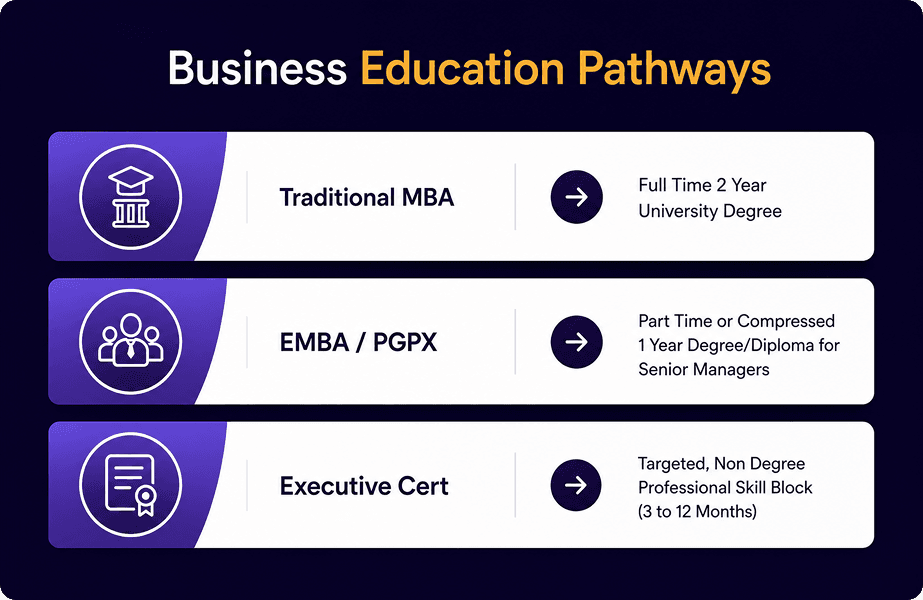
Before you can decide between an executive certification vs MBA, you need to understand what each one actually is and what it is not.
What Is an MBA?
An MBA (Master of Business Administration) is a postgraduate degree, typically 2 years full-time, offered by universities and business schools. In India, the equivalent at IIMs is called a PGDM (Post Graduate Diploma in Management), which carries the same industry weight as an MBA.
To get into a top MBA program in India like IIM Ahmedabad, Bangalore, Calcutta, or similar, you need to clear CAT, go through group discussions, personal interviews, and compete with tens of thousands of applicants for a few hundred seats. The process is designed to be difficult. The output is a degree (or diploma) that signals academic rigour, institutional credibility, and 2 years of full immersion. The MBA is built on breadth. You study finance, marketing, operations, strategy, HR, economics, whether or not you'll ever use all of it. The assumption is that a general manager needs to understand every function of a business.
What Is an Executive Certification?
An executive certification is a structured, shorter-duration program, typically 6 to 12 months, offered by business schools, IIMs, IITs, and edtech platforms in partnership with them. It is not a degree. It is a certificate issued upon completion of a defined curriculum, usually designed around a specific domain (digital marketing, product management, data analytics, business leadership, etc.) or a broader management theme for senior professionals.
Crucially, most executive certification programs do not require CAT or any entrance exam. Admission is profile-based, your work experience, educational background, and sometimes a brief interview determine whether you get in. Classes run on weekends or evenings, and most working professionals complete them without taking a single day off from their jobs. The executive certification is built on depth and relevance. You study what applies to your role, your domain, and your next career step, not a 360-degree curriculum designed for 22-year-olds with no work experience.
Where Does an Executive MBA Fit In?
An Executive MBA (EMBA) is a degree programme, not a certificate. It is designed for experienced professionals, with minimum eligibility typically starting at 4 to 5 years of work experience, though the average cohort tends to have 7 to 9 years. The critical distinction that most comparisons miss: EMBA programmes at top-tier IIMs are full-time and residential, meaning you are expected to leave your job for the duration, which is typically one year. They are not a way to study while working, that is a common misconception. Some Tier-2 IIMs do offer distance or hybrid EMBA formats that allow you to continue working, but these carry different credential weights and are structured differently. So while an EMBA is shorter than a traditional two-year MBA, it still demands a career pause. It sits above an executive certification in terms of rigour, selectivity, and credential weight but comes with a similar life disruption.
The Comparison - 10 Parameters That Actually Matter
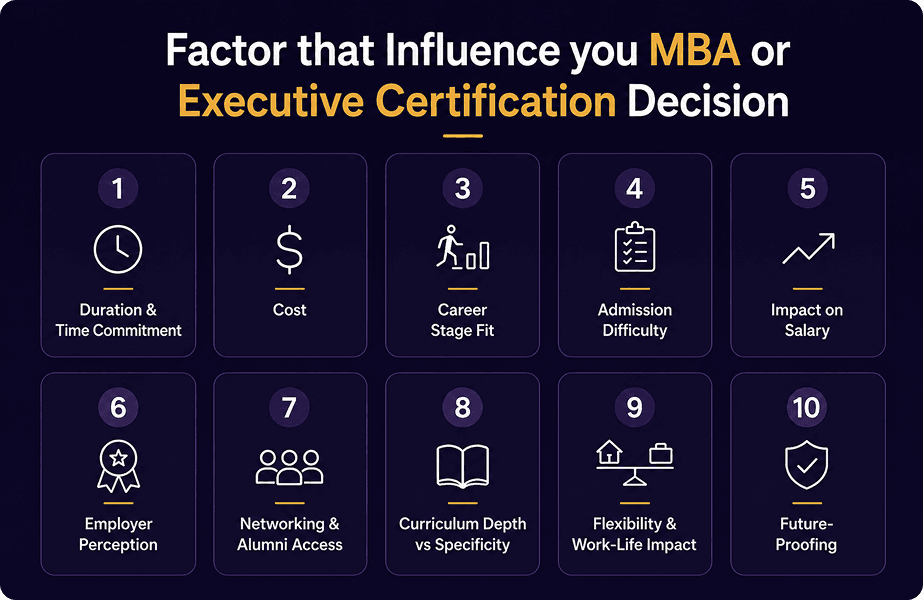
1. Duration & Time Commitment
An MBA requires 2 full years of your life. Not just 2 years on a calendar, 2 years where you are a student, not a professional. You leave your job, move to a campus, attend classes every week, and come out the other side as a fresher again (albeit a highly credentialed one). For most working professionals, this is the single biggest barrier.
An executive certification requires 8 to 15 hours per week over 6 to 12 months. You attend weekend classes (live or recorded), complete assignments, and show up to campus immersion modules (usually 2 to 5 days total, if the program includes them). Your professional life continues uninterrupted.
The time trade-off is not just about convenience. It's about what you give up. An MBA candidate gives up 2 years of salary, 2 years of work experience accumulation, and 2 years of seniority progression. An executive certification candidate gives up Saturday mornings and some weekday evenings.
Bottom line: If time is the constraint, this parameter alone is decisive.
2. Cost
A top-tier MBA in India (IIM A/B/C) costs between ₹23 lakh and ₹28 lakh in tuition alone. Add living expenses, foregone salary (typically ₹8–15 lakh per year for a mid-career professional), and the real cost of a full-time MBA is ₹30-40 lakh over 2 years. International MBAs (INSEAD, Harvard, Wharton) cross ₹1 crore easily.
Executive certifications from IIMs typically range from ₹1.5 lakh to ₹5 lakh. Some senior management programs from IIM Calcutta or IIM Kozhikode go up to ₹8–10 lakh for 12-month cohort-based programs. But there is no foregone salary - you keep earning throughout.
The total financial impact difference between the 2 paths, for a professional earning ₹12 lakh per year, can easily be ₹50 lakh or more when you account for opportunity cost.
Bottom line: Cost is the most underestimated variable in this decision. Run your actual numbers before deciding.
3. Career Stage Fit
The MBA is optimised for career launching. It works best when you're 24 to 28, have 2 to 5 years of experience, and want to either change industries, move into consulting or finance, or leap 2 levels in one jump. The MBA is a reset mechanism as much as a credential.
Executive certifications are optimised for career accelerating. They work best when you're already in a role, already know which domain you want to go deeper in, and want to formalise skills or get institutional credibility behind work you're already doing.
If you are 32, earning ₹18 lakh, managing a team, and want to move into a VP or Director role in your current industry, an executive certification is likely the more efficient lever. If you are 26, earning ₹6 lakh, and want to pivot from engineering to product strategy, an MBA may be the better reset.
Bottom line: Neither is universally better. The career stage determines which one solves your actual problem.
4. Admission Difficulty
CAT is written by over 3 lakh candidates annually. Fewer than 2,000 make it to IIM Ahmedabad, Bangalore, or Calcutta. The acceptance rate at top IIMs is under 1%. Even with a good score, GD-PI rounds filter further. For most working professionals, clearing CAT while holding a demanding job is genuinely difficult, not because they lack intelligence, but because they lack the time for 6 months of focused preparation.
Executive certification programs at the same IIMs are admitted on a rolling, profile-based basis. The screening evaluates your work experience, educational background, and professional relevance. There is no written entrance exam. Acceptance rates vary, but the process is not designed to eliminate, it is designed to match.
Bottom line: If the admission barrier of CAT is the reason you're reading this article, executive certifications are a legitimate, credible alternative, not a consolation prize.
5. Impact on Salary
This is the parameter everyone asks about first, and it deserves an honest answer. An MBA from a top-3 IIM changes salary curves dramatically. Average placement salaries at IIM Ahmedabad and IIM Bangalore regularly cross ₹25–35 lakh for domestic placements, with top offers going significantly higher. For someone who enters at ₹8 lakh and exits at ₹28 lakh, the ROI math works even with a ₹40 lakh total cost, if they stay on that trajectory.
Executive certifications do not produce the same immediate salary jump. They are not placement programs, you go back to your existing job. The salary impact is more indirect: better negotiation leverage during appraisals, stronger positioning for lateral moves, and the credibility to ask for roles with higher compensation. The salary impact from a certificate builds over time as you apply specialised strategic frameworks to your active projects.
Bottom line: The executive certification vs MBA salary gap is real in the short term. The MBA produces a faster, larger initial jump. The certification produces incremental growth over a longer arc. See the dedicated section on 5-year earnings later in this article.
6. Employer Perception
In India, the MBA brand, especially IIM, ISB, XLRI, FMS, carries enormous institutional weight. Recruiters at consulting firms, investment banks, and large conglomerates have historically filtered on degree + college combinations. For these roles, an executive certification does not substitute for an MBA.
However, employer perception is shifting. In product management, marketing, data, and technology functions, what you can do increasingly outweighs where you studied. Recruiters appreciate certification holders because it demonstrates a proactive commitment to continuous professional learning without disrupting employment history. A 35-year-old Head of Growth with an IIM Calcutta executive certification and a strong track record will be taken seriously by most hiring managers in the startup and mid-market space.
Bottom line: Depends on which industry and role you're targeting. The MBA still wins on brand perception in traditional sectors.
7. Networking & Alumni Access
The MBA alumni network from a top IIM is one of its most underrated assets. Tens of thousands of senior professionals across industries, a culture of alumni helping each other, and a brand that creates instant credibility in rooms you haven't entered yet. This network compounds over decades.
Executive certification cohorts are smaller and less storied, but they are not without value. You are in a room, virtual or physical, with 50 to 100 professionals who are currently working at real companies, dealing with real problems, and at a similar stage of their career. The peer learning and informal network from a cohort of working professionals can be immediately practical in ways that a campus network isn't.
Bottom line: MBA wins on alumni scale and long-term network depth. Executive certification offers more immediately relevant peer networks.
8. Curriculum Depth vs Specificity
An MBA curriculum is broad by design. You will study subjects that have nothing to do with your career trajectory and that is partly the point. The exposure to finance for a marketer, or operations for someone in HR, is supposed to make you a better general manager. For some people, this breadth is genuinely transformative. For others, it is 2 years of content they will never apply.
Executive certifications are narrow by design. A programme on Digital Marketing and Growth, or Data Science for Business Leaders, or Strategic Management for Senior Professionals is built to deliver applicable skills in a defined domain. The curriculum has a job to do, prepare you for a specific next step and it is evaluated on whether it does that.
Bottom line: If you know what you want to do next, the certification's specificity is a feature. If you don't know yet, the MBA's breadth is more valuable.
9. Flexibility & Work-Life Impact
Pursuing a full time degree requires completely disrupting your personal life, moving onto a campus, and halting your income. This path can create immense personal and financial anxiety if you already have family responsibilities or home loan payments.
Executive tracks offer excellent flexibility, allowing you to balance your studies alongside your active personal and corporate schedules. You can absorb recorded modules or attend live weekend virtual classrooms without neglecting your existing life commitments.
Bottom line: If you cannot or will not leave your job, this parameter is non-negotiable. Executive certifications are designed for you.
10. Future-Proofing
The MBA remains a powerful credential, but its monopoly on business education is eroding. The rise of specialised master's degrees, executive programmes from global institutions, and online credentials from IIMs and IITs has created a broader ecosystem where multiple paths lead to senior roles.
The skills economy is real, particularly in technology-adjacent functions. A professional with demonstrated capability in product management, growth marketing, or data strategy, backed by an IIM executive certification, is competitive for roles that would have required an MBA a decade ago.
On the other hand, if your 10-year goal involves a top-tier consulting firm, a CFO role at a large corporation, or senior leadership at an FMCG company, the MBA from a top institution remains close to irreplaceable.
Know More about Executive Education Fees and ROI
Bottom line: The MBA is more future-proof as a general credential. Executive certifications are more future-proof as domain-specific signals in a fast-changing skills landscape.
The Decision Framework
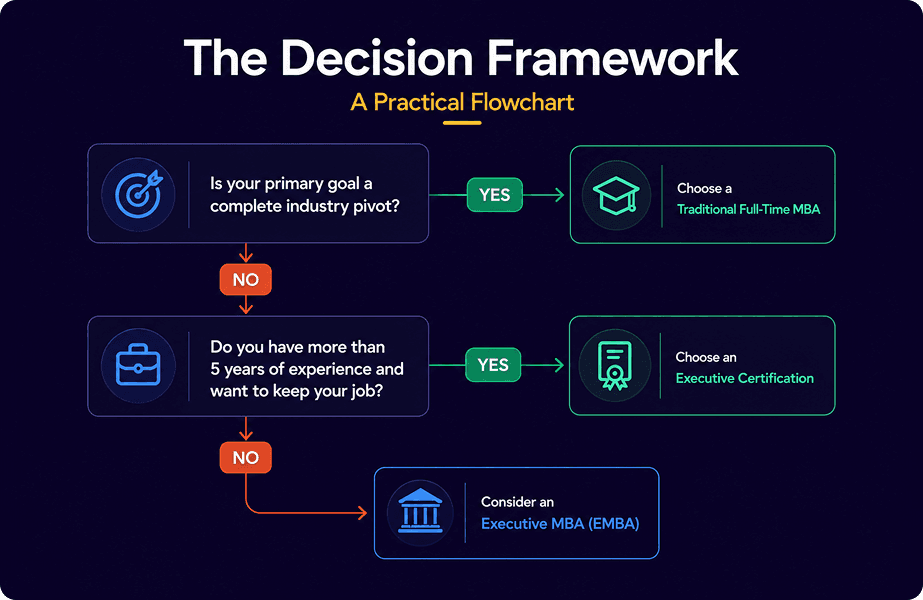
Use this to cut through the noise.
Choose an MBA if:
You are willing to pause your career for 2 years.
You have fewer than five years of professional work experience and want structured campus placements.
You want to execute a total career pivot into a completely different industry or functional domain.
You have cleared or can realistically clear CAT with 3–6 months of preparation.
You can fund the cost (via savings, loan, or scholarship) without long-term financial stress.
You are looking for a credential that works in every context, across every industry, for the rest of your career.
Choose an Executive Certification if:
You cannot leave your current job.
You have over five years of solid corporate experience and want an executive certification better than MBA paths for your lifestyle.
You want an IIM credential without the 2-year commitment or CAT.
You are looking to accelerate within your current industry rather than pivot out.
You need the credential to work in 6–12 months, not 3 years from now.
Consider an EMBA or PGPX if:
You have 8+ years of experience and are already at a senior level.
You can afford a higher-cost programme (₹15–35 lakh) and want degree-level credentials.
You want the MBA brand without full-time campus commitment.
You have significant managerial tenure and want to engage in deep strategic discussions with senior peer cohorts.
Real Scenarios - 5 Professionals, 5 Different Right Answers
Abstract definitions only go so far. To understand where you fit, it helps to look at real career dilemmas. Here is how five different professionals mapped out their decisions.
Scenario 1: The Code-Weary Engineer
At 25, Amit feels like he is staring at a wall. He has spent 2 years writing code at a software firm, but he does not want to be a developer forever. He wants a seat at the table where product strategy and business consulting happen.
The Best Move: A traditional full time MBA. Amit is early enough in his career to pause, move onto a campus, and reboot. The intense immersion and structured placement drives are designed exactly for profiles like his.
Scenario 2: The Fast-Track Marketer
Priya loves the consumer goods industry. At 34, she has spent 9 years climbing the ladder to regional marketing manager. She wants a director seat next, but the game is changing. She knows she cannot lead a modern team without deep digital data fluency.
The Best Move: An executive certification. Priya does not need to waste time relearning basic business concepts. She needs targeted, modern skills she can apply at work on Monday without sacrificing her momentum or her salary.
Scenario 3: The Exhausted CAT Aspirant
Rahul is 27 and tired. He has spent 2 grueling years working as an operations analyst by day and solving algebra puzzles by night for the CAT. He just missed the cutoffs for the top three management institutes, and the thought of resetting the clock feels soul crushing.
The Best Move: Look at long term executive programmes at premier business schools. Rahul already has corporate experience. He can bypass the entrance exams entirely and use a profile based admission track to get the exact same brand on his resume.
Scenario 4: The Golden Handcuff Dilemma
Vikram is 38, a brilliant engineering lead, and completely bound by real world responsibilities. He has a family, school fees, and a hefty home loan payment due every single month. He wants a premier institutional credential to secure a vice president role, but taking a career break is financially impossible.
The Best Move: A hybrid executive course. Vikram can access elite faculty and weekend campus modules without missing a single paycheck. It allows him to manage his family commitments while upgrading his professional standing.
Scenario 5: The Boardroom Bound Executive
At forty five, Suresh has spent 20 years navigating global logistics. As a vice president, he already knows how to run a business. Now, he is being considered for the chief executive seat. He does not need a job offer; he needs to master corporate governance and global macroeconomic strategy.
The Best Move: A modular executive certification or a senior management track. Suresh does not need placement cells. He needs sharp, high level strategic perspectives and a sounding board of true corporate peers who share his level of responsibility.
Who Earns More After 5 Years?
This is the executive certification vs MBA salary question everyone wants answered honestly. The 5 year earnings comparison depends heavily on where you start and which MBA or certification you choose. A premier full time business degree usually provides a dramatic, immediate compensation spike right after graduation.
However, when you calculate the net financial metrics over five years, the total trajectory looks surprisingly balanced. The full time graduate starts with a higher baseline but must first pay off substantial student loans. They must also recover the income lost during their two year employment gap.
The executive certificate holder maintains their steady salary trajectory throughout their studies without taking on massive debt blocks. Their financial growth happens through consistent internal promotions, performance bonuses, and targeted lateral moves fueled by their new skills.
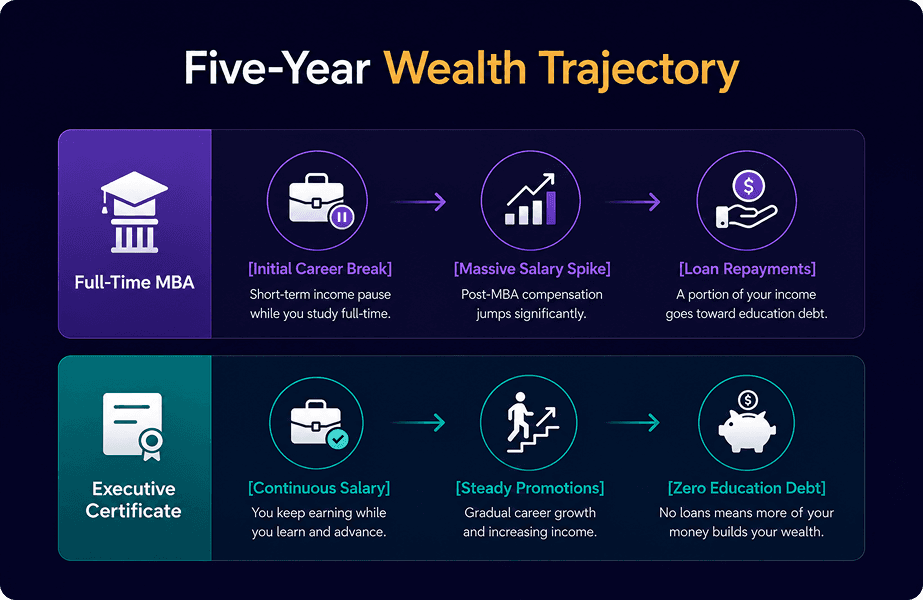
By year five, an executive professional who applies their specialised knowledge aggressively can achieve parity with a full time graduate. The key difference is that the certificate holder achieved this financial growth without disrupting their corporate momentum.
Run your own numbers. Factor in your current salary, programme cost, foregone earnings, and realistic post-programme salary range, not best-case scenarios.
Why "Certification vs MBA" May Be the Wrong Question
Most people frame this as a competition. It isn't. The MBA and the executive certification solve different problems for different people at different stages. The question is not which one is better, it is which one is better for you, right now, given your goals, your constraints, and your timeline.
As the business world evolves, that initial general knowledge will naturally require periodic targeted upgrades. An executive certification does not need to replace a traditional management degree over the course of your career.
The executive certification vs MBA debate matters most when you're at a genuine inflection point, when the credential will meaningfully change what opportunities open to you. At that point, the decision deserves serious thought, honest financial modelling, and clarity about what problem you're actually trying to solve.
Share :
Frequently asked questions (FAQs)
For any unanswered questions, reach out to our support team via contact us page or email. We'll respond with-in a day to assist you.