
The L&D Budget Planning Mistakes Most HR Leaders Make - And How to Avoid Them

Share :

Learning and development (L&D) has become a crucial workforce strategy. It focuses on training to build skills, improve performance, prepare future leaders, and support business transformation. Every year, many HRs and CHROs face the same challenge: the daunting task of L&D budget planning. The goal is to allocate a limited budget across leadership development, technical training, executive education, digital skills, and employee development. An effective L&D budget requires more than deciding how much to spend. It means aligning investments with business priorities, identifying critical skill gaps, and choosing learning initiatives that create measurable value. HR leaders need to understand how learning investments can support business growth.
Planning this is not easy. A poorly planned L&D budget may quickly turn into a collection of disconnected courses that offer no practical benefits. The employees may attend the programme without ever applying what they learn. To ensure there are no unused budgets left, or that teams don't struggle to access relevant learning opportunities, HRs must plan effectively.
Here are some common mistakes HR leaders and CHROs make when planning the L&D budget and practical ways to avoid them.
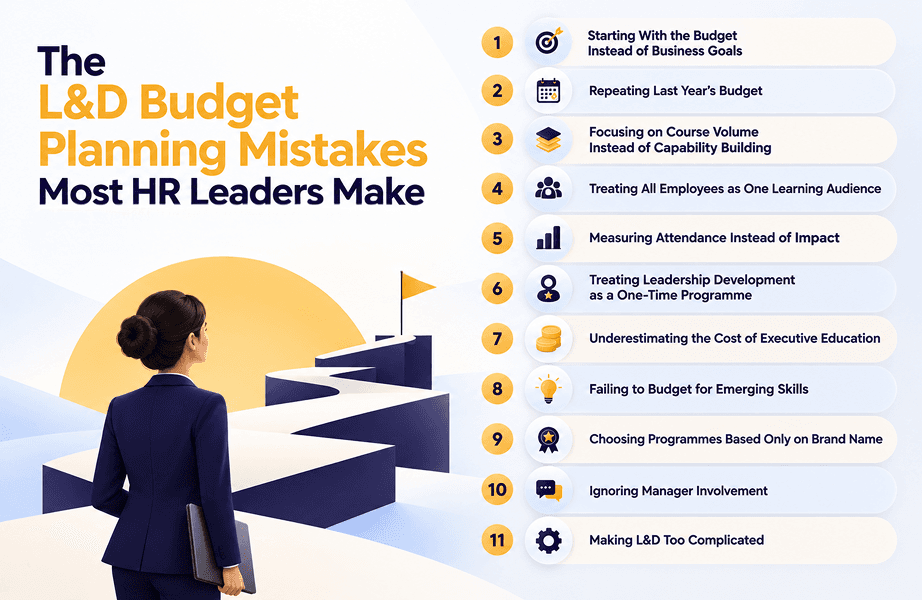
1. Starting With the Budget Instead of Business Goals
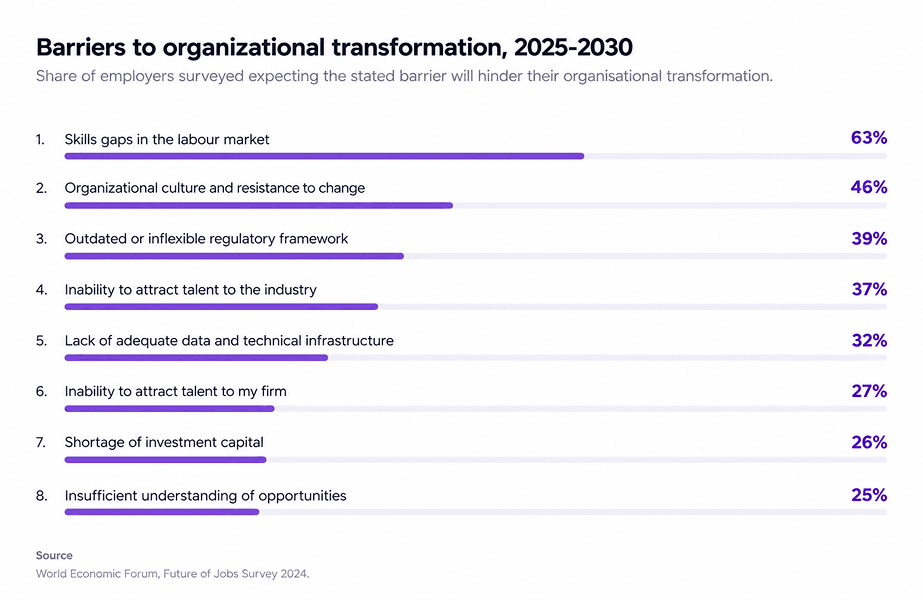
HR leaders often begin the planning process with a fixed number. The usual approach is to receive an annual L&D training allocation and divide it across departments, courses, and training categories. This approach may look organised but isn't necessarily strategic. L&D planning should begin with analysing business priorities to allocate funds for learning opportunities that align with broader goals. According to the World Economic Forum’s Future of Jobs Report 2025, 63% of employers identify skills gaps as a major barrier to business transformation.
How to avoid it
Start by asking:
What are the organisation's major business priorities?
Which skills are needed to achieve them?
Where are the biggest capability gaps?
Which teams need these skills most urgently?
Which capabilities will become important over the next two to three years?
Once these questions are answered, the budget can be allocated according to business needs rather than historical spending patterns. Using tools like Echomind Budget Planner can help HR teams map spending directly to organisational priorities right from the start.
2. Repeating Last Year's Budget
HR leaders need to stop treating previous years' L&D budget as a default template. This might create continuity but can also preserve outdated business priorities. The skills an organisation needed three years ago may not be the same skills they need today. New technologies, changing customer expectations, and evolving business models can quickly change capability requirements.
How to avoid it
Review the previous year's spending before creating the new budget. And use those insights to redesign the next budget.
Look at:
Which programmes had strong participation?
Which programmes had low enrolment?
Which skills were actually applied?
Which departments requested additional learning support?
Which programmes produced measurable business outcomes?
Which areas received funding without clear evidence of impact?
3. Focusing on Course Volume Instead of Capability Building
An organisation offering hundreds of courses does not necessarily translate into capability development. One can have an impressive L&D budget with multiple courses available, but without actual learning, they provide no value. The World Economic Forum estimates that 39% of workers' existing skill sets will be transformed or become outdated between 2025 and 2030. Employees may complete several short courses without developing meaningful proficiency in a particular skill. The objective should therefore move from course consumption to capability development.
How to avoid it
Focus on identifying specific capabilities that matter to different roles. This changes the conversation from participation to outcomes.
4. Treating All Employees as One Learning Audience
When planning L&D budgets, HR leaders need to keep in mind that every employee is at a different career stage and needs training in different skills. Each employee has different learning needs based on their roles, responsibilities and career stages. A single L&D strategy may not address these differences effectively. A junior employee, a mid-level manager, and a senior executive do not necessarily need the same learning experience or resource commitment. The same goes for people performing different functions, working in different locations, or working toward different future goals.
Let us take an example to understand this better. Imagine a company with a ₹40 lakh annual L&D budget.
Initial allocation
Employee group | Allocation | Approach |
2 Senior Executives | ₹12 lakh | General leadership programmes |
4 Mid Level Managers | ₹12 lakh | Standard training programmes |
8 Junior Employees | ₹16 lakh | General skills training |
This approach spreads the budget across employee groups but does not adequately address the organisation's most critical capability gaps.
A more targeted approach
Employee group | Allocation | Approach |
2 Senior Executives | ₹12 lakh | Advanced leadership development |
4 Mid Level Managers | ₹16 lakh | Specialised technical certifications |
8 Junior Employees | ₹12 lakh | Targeted foundational training |
Total: ₹40 lakh
The same budget can create greater impact when learning investments are aligned with role, skill gaps and business priorities, rather than distributed broadly across employees.
How to avoid it
Segment learning requirements based on:
Role
Seniority
Function
Career stage
Current skill level
Future role requirements
Tools like Echomind Explorer can help HR teams discover key programme details together, and compare options side by side. It helps in tailoring learning pathways for distinct employee segments and creates a more targeted learning strategy.
5. Measuring Attendance Instead of Impact
Attendance is easy to measure. Business impact is harder. This is why many L&D teams report metrics such as:
Number of programmes conducted
Number of employees trained
Hours of training delivered
Completion rates
Training satisfaction scores
These metrics are useful, but they do not necessarily show whether learning changed performance.
How to avoid it
Build an evaluation framework before approving major programmes. Depending on the learning objective, HR teams can examine:
Changes in productivity
Skill assessments
Employee performance
Internal mobility
Project outcomes
Employee retention
Application of new skills
6. Treating Leadership Development as a One-Time Programme
Usually in L&D training, leadership development is often included as a workshop or an annual programme. These small workshops can introduce useful concepts, but sustainable development requires continued practice. A leader isn't built in one day. Leadership development is a journey, as leadership capabilities develop over time. Exposure to real-world leadership situations is extremely important to prepare employees for larger roles.
How to avoid it
A leadership development budget can include:
Executive education
Coaching
Mentoring
Peer learning
Leadership projects
Cross-functional assignments
Strategic simulations
Management programmes

7. Underestimating the Cost of Executive Programmes
Oftentimes HR teams evaluate programmes only by their course fees. They forget to consider the unquantifiable cost of not developing these critical capabilities. Executive programmes can provide experienced professionals with specialised knowledge in areas such as strategy, leadership, digital transformation and business management. These help professionals have smoother internal mobility and get better in cross-functional areas.
How to avoid it
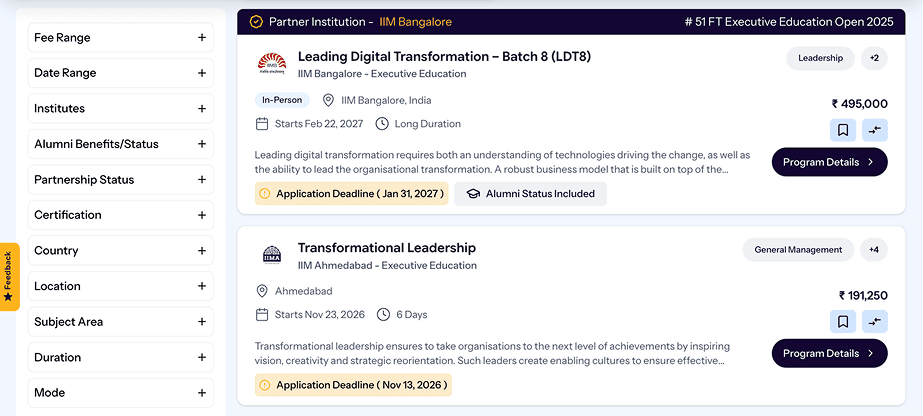
HR leaders should try to compare programmes on the basis of value rather than price alone. They must evaluate executive programmes using a broader investment framework. HR leaders can use Echomind Explorer to analyse, evaluate, and benchmark various programmes across key factors and do easy side-by-side comparisons.
Consider:
Programme cost
Employee time
Relevance to the role
Quality of the institution
Practical application
Expected business impact
Long-term capability development
8. Failing to Budget for Emerging Skills
If the L&D budget is built entirely around existing job descriptions, emerging capability requirements may be overlooked. Artificial intelligence is a clear example of how tech-driven changes can make some skills increasingly important in a short time. Experienced employees also need exposure to changing workflows, especially AI-enabled ones.
How to avoid it
HR leaders can avoid this by including a dedicated component for emerging skills. Depending on the organisation, this could include:
Artificial intelligence
Data literacy
Automation
Digital transformation
Cybersecurity awareness
Sustainability
New management practices
The objective is not to train everyone in every emerging technology. It is to identify where new skills could materially affect specific roles or business functions.
9. Choosing Programmes Based Only on Brand Name
Institutional reputation can be an important consideration when selecting an executive programme. However, brand recognition alone should not determine an L&D investment. A prestigious programme may still be poorly aligned with the organisation's specific capability requirements. Echomind helps shift the focus from simply finding a prestigious programme to finding one that fits the professional's goals.
How to avoid it
The right programme is one that addresses the capability requirement, not simply one with the most recognisable name. HR leaders must evaluate programmes against clearly defined criteria that align with the learning goals of the organisation. Ask whether the programme offers:
Relevant curriculum
Experienced faculty
Practical projects
Industry exposure
Suitable learning formats
Appropriate difficulty level
Relevant peer interaction
10. Ignoring Manager Involvement
An employee completes a programme, returns to work, and finds their manager has no interest in the new frameworks. This creates a gap between learning and performance. Hence, it is important to include managers in the learning process as well.
How to avoid it
Managers can help employees:
Identify relevant programmes
Set learning objectives
Apply new skills
Receive feedback
Discuss progress
Work on practical assignments
This makes learning part of the employee's work rather than an activity separate from it.
11. Making L&D Too Complicated
The L&D budget planning is already a complex task. HR teams use multiple vendors, learning platforms, consultants and approval processes, which adds another layer of complexity. Employees have to search through numerous catalogues before finding a suitable programme. This leads to reduced participation and creates difficulty for HR teams to track spending.
How to avoid it
Opt for a simpler learning ecosystem like Echomind Explorer to discover and compare programmes.
Centralise information where possible.
Categorise programmes by skill, role and career stage.
Give clear guidance on how to identify relevant learning opportunities.
Use tools like Echomind Budget Planner to simplify L&D budget planning for your team.
How to Plan Next Year's L&D Budget in Five Steps
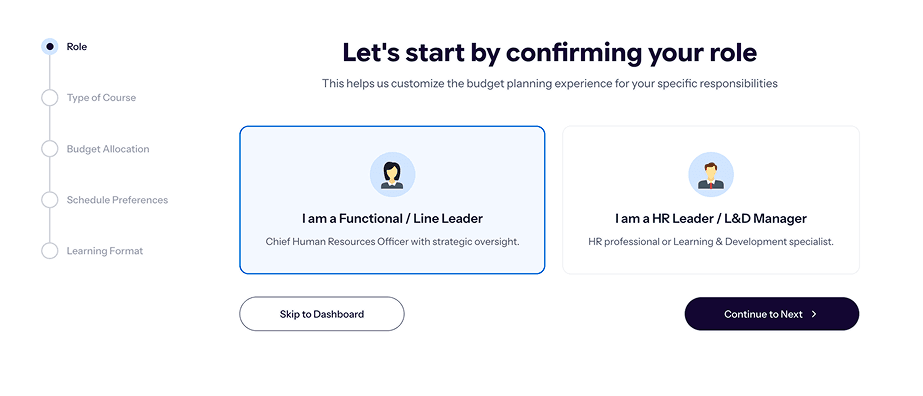
Traditionally, L&D budget planning was hectic and time-consuming. Echomind fills this gap. It brings all these parts into one workflow, making it easier for HR leaders and L&D teams. With Echomind Budget Planner, you can plan next year’s L&D budget in 5 simple steps:
1. Start Planning Learning for Your Team
Begin by selecting “Plan learning for my team” and choosing your relevant role on Echomind Explorer. This gives a starting point for building a learning plan around your team’s development needs.
2. Find Programmes That Match Your Team’s Development Needs
Explore and compare programmes that align with the skills, capabilities and development requirements of your team. Echomind Explorer helps filter programmes across institutions, subjects and formats. This helps you move from broad learning requirements to relevant programme choices.
3. Set Your Total L&D Budget
As you move forward in the Echomind budget planner, enter the total budget available for your team’s learning and development. Then determine how to divide the budget across different teams, seniority levels, roles, or learning requirements.
4. Allocate the Budget Across Your Teams
Plan how much of the available budget should go towards different employee groups or development priorities. This makes it easier to see where your L&D investment is going before finalising programme choices.
5. Set Your Learning Preferences
Refine the plan based on your preferred schedule, programme duration, course length and mode of learning. This helps ensure that the programmes selected are practical for your team and fit within their work commitments.
After completing these steps, you have a well-planned L&D budget without any hassle with the help of Echomind Budget Planner. The allocated fund is being used to bring tangible learning outcomes aligning with organisational goals.
A Strategic L&D Budget: Every Rupee Works Towards a Capability Goal
An effective L&D budget is not simply a list of courses with allocated costs. It is a strategic investment in the capabilities an organisation needs to grow. HR leaders can improve their L&D planning by connecting learning with business priorities, identifying specific skill gaps and measuring outcomes beyond attendance. By comparing programme costs, formats, duration, and expected outcomes, HR leaders and CHROs can make more informed allocation decisions.
A budget planning tool can help bring different learning investments into one view before decisions are finalised. This is where Echomind supports the process. Echomind brings executive, leadership, and management programmes from leading institutions in India and globally into one platform. It helps organisations and professionals discover programmes aligned with specific development needs. Echomind is a one-stop solution to make L&D budget planning smoother. HRs can explore courses based on individual needs and use tools that help with comparing and spending. The goal is simple: spend the L&D budget where it builds the capabilities your organisation needs next.
Share :
Frequently asked questions (FAQs)
For any unanswered questions, reach out to our support team via contact us page or email. We'll respond with-in a day to assist you.