
How to Know If You Actually Need an Executive Program or If You're Just Feeling Stuck

Share :

Most professionals do not plan the moment they start looking at executive programmes. There is no calendar reminder. No strategic review meeting where someone suggests it. It usually happens quietly, late on a weeknight, after a meeting that left you feeling invisible, or after a colleague's promotion announcement landed differently than you expected.
You open a tab. You start comparing programmes. It feels like doing something. That impulse is understandable. The discomfort behind it is real. But the discomfort does not always mean what you think it means and acting on it too quickly, with the wrong diagnosis, is one of the more expensive mistakes a mid-career professional can make.
Sometimes the search means you have genuinely outgrown your current role and need structured learning to reach the next one. Sometimes it means you are exhausted, underappreciated, or quietly burnt out and an executive programme is the most productive-sounding escape route your mind could find. This article will help you tell the difference, honestly and without the usual career-advice reassurances.
The Feeling That Sends Most Professionals Googling
It rarely announces itself as a crisis. That would almost be easier to deal with. Instead it is subtler. You are good at your job, genuinely good. You have built something real over the last several years. But somewhere in the recent past, the growth stopped feeling like growth. Promotions are taking longer than they should. The interesting work keeps going to someone else. You sit in leadership meetings and contribute, but leave wondering if anything you said actually mattered.
This is the plateau. Almost every serious professional hits it at some point between year 5 and year 10. It is uncomfortable, disorienting, and has a way of making everything feel more urgent than it probably is.
Here is what makes it complicated. The plateau can mean 2 completely different things. It can mean you need new skills, a sharper credential, or a structured push into a different level of responsibility. Or it can mean something is fundamentally wrong at your workplace and you are unconsciously framing a people problem, or a culture problem, as a career development problem. An executive programme can solve the first. It cannot touch the second. And the two can feel identical from the inside.
Two Very Different Reasons People Consider Executive Programmes
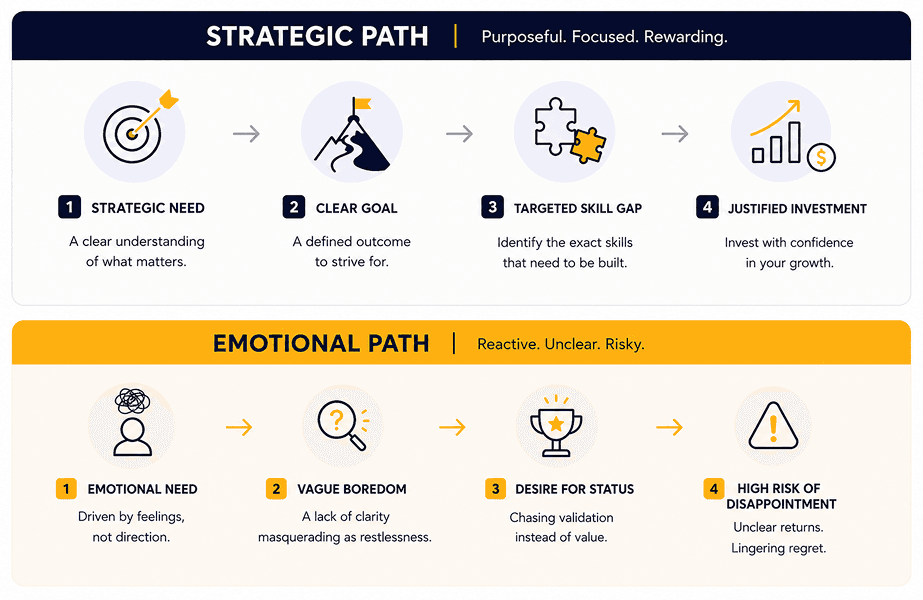
Before you shortlist institutions or start calculating EMIs, it is worth being genuinely honest with yourself about what is driving the search. The strategic reason looks like this. You have a specific destination in mind, a role, a function, a level of seniority. You have a reasonable sense of what is standing between you and that destination. You have identified that structured learning, or the credibility of an institutional credential, will help remove that barrier. The programme is a means to a clearly defined end.
The emotional reason looks like this. Something at work has stopped feeling right. You feel overlooked, underutilised, or quietly panicked about where your peers are relative to where you are. An executive programme feels like momentum. It feels like you are taking your career seriously. The name of the institution on the certificate feels like it will shift how people see you.
Neither of these makes you a bad professional or a weak decision-maker. These feelings are human and they are common. But they lead to very different outcomes. The professional with a strategic reason tends to get a ROI, in role, in salary, in what they can do. The professional driven primarily by the emotional reason tends to finish the programme and find the same restlessness waiting on the other side, now with a lighter bank account.
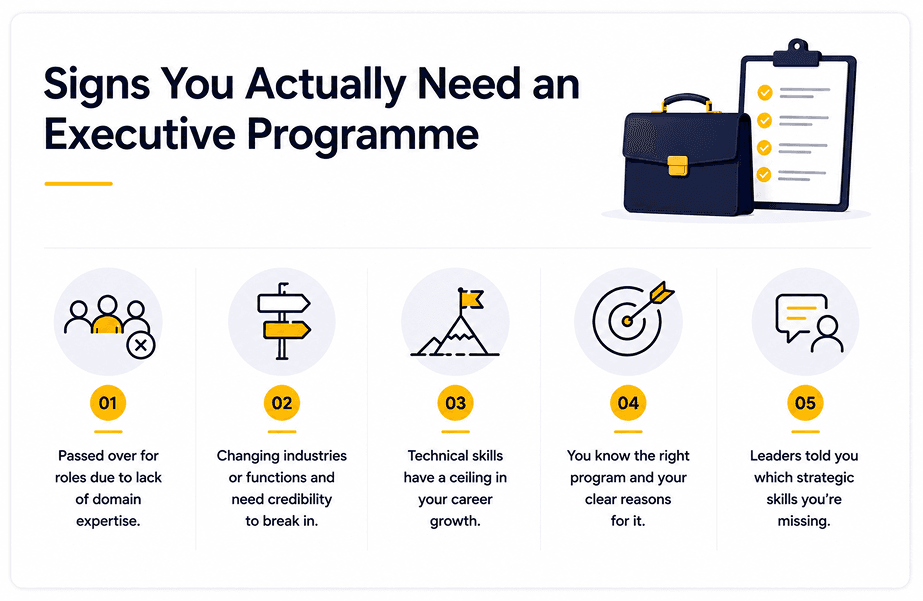
Signs You Actually Need an Executive Programme
To ensure you are making a logical choice, look for concrete, undeniable signals in your current workplace. These are not vague feelings of ambition; they are real, identifiable corporate situations.
You are repeatedly being passed over for leadership roles that require specific domain knowledge you do not possess.
You are actively changing industries or functional domains and need structured credibility to open new institutional doors.
Your current technical skills have a visible ceiling in your target corporate hierarchy.
You know exactly which program you want and why, rather than just chasing a prestigious brand name.
Your manager or external hiring panels have explicitly told you what strategic frameworks are missing from your profile.
If your daily professional life matches these scenarios, your need for structured education is entirely real. A classroom environment will give you the practical toolsets required to break through your current ceiling.
Signs You Are Probably Just Feeling Stuck
On the flip side, the desire to go back to school can often be a coping mechanism for general workplace unhappiness. Be entirely honest with yourself if you recognize these patterns.
You cannot articulate the exact corporate role or responsibility the chosen program prepares you to handle.
You have been passively researching executive courses for months but have not filled out a single application form.
The primary appeal is the prestige of the credential rather than the actual subjects listed in the syllabus.
You are deeply unhappy at your current company but are framing it as a broader career problem.
You are constantly comparing your timeline to peers who did early full time degrees and are feeling left behind.
When these signs appear, a new qualification will not solve the underlying issue. You are likely craving a change of scenery or a culture shift, not a heavy academic schedule.
The Question That Cuts Through Everything
If you are struggling to separate strategy from emotion, there is one diagnostic question that will clarify your thinking. Ask yourself this: if I had this credential tomorrow morning, what specifically would change in my career? Not how you would feel. Not how others might perceive you in a general sense. What would concretely and measurably change in your professional life within the next twelve to eighteen months?
If you can answer that with absolute concreteness, your educational path is fully justified. You might point to a specific vice president role, a clear salary band, or a distinct industry door that will open.
However, if your internal answer remains vague, you need to pause. Phrases like "I would feel more confident" or "people would take me more seriously" are emotional desires. Confidence is built through execution and boundary setting, not through an institutional parchment document.
The ROI of Executive Certificates
What to Do If You Are Just Feeling Stuck
The feeling is real and it deserves a real response. Just not necessarily an expensive one.
Start with a direct, honest conversation with your manager about your growth trajectory. Ask where they see you in two years and what would need to be true to get there. Most professionals avoid this conversation for far too long and spend years assuming the ceiling is lower than it actually is.
Seek out a project or an initiative that puts you in a different room, in front of different stakeholders, doing something outside your current remit. Internal visibility moves faster than most people expect and costs nothing.
Before you assume a credential is the entry ticket to the roles you want, talk to people who are already doing that work. Ask them how they got there. Ask what they would do differently. Their answers will be more useful than any programme brochure.
And ask yourself, with some honesty, whether the problem is your career or your company. Those are different problems. They have different solutions.
What to Do If You Do Actually Need an Executive Programme
If you have genuinely worked through the above and the need is real, here is how to approach the decision well.
Start with the outcome, not the institution. Be specific about the role, the function, or the level of seniority you are moving towards. Then find the programme whose curriculum, alumni outcomes, and cohort profile most directly serve that destination. Do not start with the brand and build a justification backwards.
Look at where alumni from that specific programme have landed in your domain, not average salary statistics across a diverse cohort, but actual people doing the work you want to be doing. That is the most reliable signal of whether the programme delivers on its promise for someone in your position.
Apply with a clear sense of purpose. The professionals who extract the most from these programmes are the ones who arrive knowing exactly what they came for. That clarity shapes every conversation, every case study, every connection you make in the cohort. It also determines what you do with the credential once you have it, which, in the end, matters far more than the credential itself.
The Honest Bottom Line
An executive programme is a tool. A good one, when used correctly. It opens doors, builds credibility, and can meaningfully accelerate a trajectory that is already in motion. But it does not manufacture momentum from nothing. It does not repair a broken workplace dynamic. It does not resolve the quieter anxieties of feeling behind or overlooked or uncertain about the future. And it does not substitute for the clarity that only you can arrive at.
The professionals who get the most lasting value from these programmes are not the ones who need rescuing. They are the ones who already knew what they were building, and used the programme to build it faster and with more credibility behind them. If that describes where you are, the investment is worth serious consideration. If you are not quite there yet, figuring that out first is the more valuable work, and it costs nothing.
Not sure which programme fits where you actually want to go? Echomind's programme explorer matches you based on your career stage, domain, and goals and not just rankings.
Share :