
Online Executive Programmes in India - What to Look For Beyond the Brand Name

Share :

As businesses, technologies, and workplace expectations evolve, senior and mid-level professionals are expected to keep evolving with them. They need to adapt to changing workflows, develop cross-functional fluency and gain strong business understanding. Executive programmes are for experienced professionals who want to build these capabilities on their existing years of experience. In India, executive education is becoming an increasingly important part of professional growth.
When we talk about learning management and executive programmes, we tend to think of traditional MBA degrees or classroom-based programmes at business schools. Offline programmes offer face-to-face networking and classroom interaction. But offline programmes expect professionals to step away from their careers. Online executive programmes gained traction because time, location, and career are not significant constraints in the learning process. Professionals can continue working while pursuing a programme, without taking a career break or committing to a sabbatical. They do not have to relocate to another city, sacrifice their salary or reorganise their lives around a campus schedule. Live online sessions, recorded learning resources, and digital collaboration can allow professionals to fit education around existing work commitments. This is particularly relevant for professionals, for whom time and location can be significant constraints. Now when it comes to choosing an online executive programme, professionals typically weigh a similar set of factors. They can vary from institute reputation, curriculum fit, peer group, and learning format and brand name usually dominates this list. But a recognisable name doesn't guarantee the right fit. Choosing well means looking beyond the brand to what the programme actually offers. This is where a structured discovery tool like Echomind Explorer can make the initial research easier. Echomind Explorer helps professionals discover and shortlist executive programmes based on their career goals and capability needs. Let's see what goes beyond the brand name when choosing the right online executive programme.
How to Choose the Right Online Executive Education Programme
Today, many universities, edtech platforms, business schools, and corporate learning providers offer several programmes across disciplines. Usually, professionals focus on the brand name on the certificate and overlook the factors that matter more. So how do you choose the right executive programme? Start by considering factors like programme duration, career alignment, curriculum, faculty, peer group, and projects. As you look beyond the brand name and alumni network, evaluate how the executive programme makes an impact on your career.
Start by asking questions like:
Does it target your specific capability needs?
Does it build on existing experience rather than repeat basics?
Does it offer diverse perspectives and practical business problems?
Can you apply it to your targeted next roles?
An effective executive programme closes capability gaps and prepares professionals for complex roles. Beyond brand reputation, Echomind helps professionals evaluate learning value. Key considerations include:
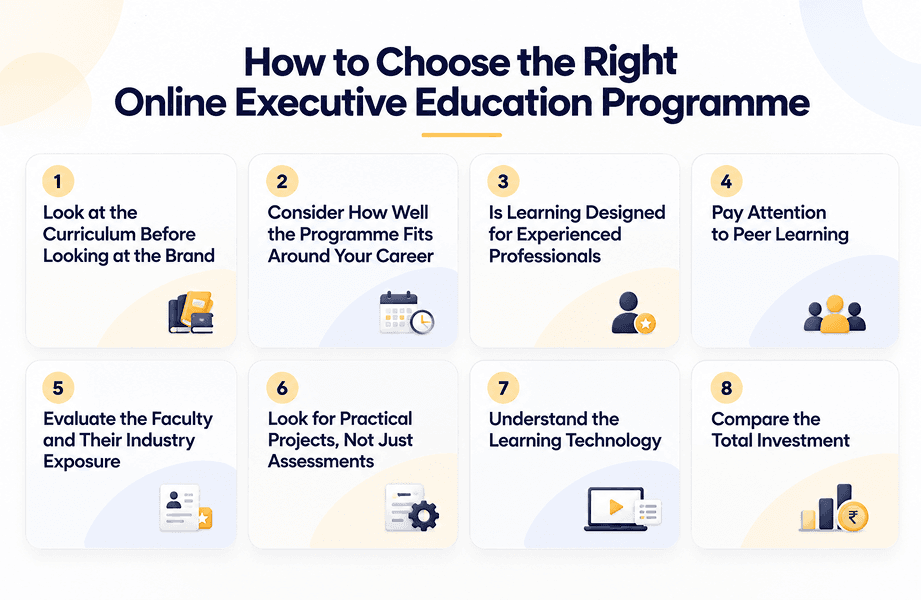
1. Look at the Curriculum Before Looking at the Brand
How do we know that an executive programme is strong? Check if it actually addresses problems encountered by professionals at work. The first step is to examine the curriculum. A good curriculum will clearly answer what you will be able to do better after completing the programme. When examining the curriculum, check if it covers current business practices and emerging skills. Does the programme help you understand how theoretical concepts apply in real organisations?
A professional moving towards a managerial or strategic role may need more than functional expertise. They need to understand business strategy, decision-making, data interpretation, leadership, and cross-functional collaboration. By examining the modules and depth of coverage, one can analyse whether the programme is worth investing their time and money in. When comparing multiple programmes, our website can help narrow the search around specific capability areas before you assess the curriculum in detail.
2. Consider How Well the Programme Fits Around Your Career
Before investing in any programme, check if it fits your career. Flexibility is one of the primary reasons professionals consider online executive programmes. You already have responsibilities at your level; it is important to make a realistic analysis before adding more. Online learning does not mean less responsibility. Examine the schedule, live-session requirements, recorded content, assignment deadlines and expected weekly workload. Consider how these requirements fit alongside your current responsibilities. A programme that is difficult to sustain alongside your job is not the perfect fit for you. So find a learning format that suits you and commit to that.
3. Check Whether the Learning is Built for Experienced Professionals
Executive education is different from undergraduate or entry-level learning. Working professionals bring experience, existing knowledge, and workplace context to the programme. An effective programme should make use of that experience rather than treating every learner as a beginner.
Any good executive programme should include discussion, case analysis, problem-solving, and application. The learning experience should allow professionals to connect new frameworks with situations they have already encountered at work. This makes the programme more valuable for professionals from different industries. Don’t just sign up because it says ‘executive’. See if their teaching approach reflects the needs of experienced professionals. Echomind brings together programmes that offer different approaches to executive learning, allowing professionals to find a format that suits them.
4. Pay Attention to Peer Learning
A major benefit of an executive programme is the opportunity to learn from professionals from different walks of life. Your peers come from different industries, functions, locations, and career stages. By interacting with them, you gain insight into their experiences, their business strategies, and their perspectives, which is hard to get from just recorded lectures. So a good executive programme must facilitate peer interactions and group activities. Check if there are live discussions, group projects, and networking opportunities. Learning doesn't stop after a class ends. The conversations with peers will expose you to different approaches to leadership, technology adoption, organisational challenges, and career development. An executive programme with meaningful collaboration can turn the classroom into a professional learning network.
5. Evaluate the Faculty and Their Industry Exposure
The faculty plays a major role in influencing how concepts are explained, challenged, and applied. When choosing a course, look beyond the academic credentials of the faculty. Look at their research background, industry exposure, experience, and teaching methods. A well-designed executive programme bridges both practitioners and academics. Skilled instructors bridge the gap between academic models and live organisational challenges. It is important to learn how much faculty interaction a programme offers. Don’t focus on the impressive names; focus on how much individual interaction you will get with them.
6. Look for Practical Projects, Not Just Assessments
Application is important when the goal is career progression. Completing quizzes and assessments shows that you understood the course. However, executive education is about learning the practical application of new frameworks. Working on projects encourages professionals to apply those new frameworks to realistic business situations. This can involve analysing a problem, developing a strategy, interpreting data, evaluating alternatives, or presenting a recommendation.
When evaluating a programme, ask:
What kind of projects will I work on?
Are they individual or collaborative?
Are they based on real business scenarios?
Will I receive feedback?
Can I connect projects to challenges in my own organisation?
Using these questions to evaluate a programme will help in selecting a better aligned executive programme.
7. Understand the Learning Technology
Since digitisation, technology has made learning easier and more accessible. When working professionals choose online programmes, they must consider the platform's usability. Look at how the content is delivered. Check if they provide interactive sessions, recorded resources, assessments, discussion forums, and easy access to course materials. See what formats a programme incorporates in its teaching process: video lectures, live sessions, projects, peer interactions, etc. The best format strikes a balance between self-paced learning and live learning.
8. Compare the Total Investment
Programme fees are an obvious consideration, but that is not the entire cost. You assess the value of the course on the basis of the price range. It doesn't matter if it falls on the lower end or the higher end. What matters is whether it aligns with your learning goals, fits your budget, and meets your needs. The question you should be asking is: what do you receive in return for the money and time you are investing?
9. Certification and Recognition
While a brand name shouldn't be the sole deciding factor, the certification you earn still holds significant value. Certificates from recognized institutions validate the skills and knowledge you've acquired. It serves as credible proof of your capability to current and future employers. A respected credential enhances your resume, opens doors to new opportunities, and provides you with alumni recognition. It also complements the practical learning, career alignment, and strategic competencies developed throughout the programme.
Make the Decision Based on Your Best Fit
There is no single executive programme that will be right for every working professional. Every professional is at a different career stage and has different priorities and responsibilities. That is why the institution’s brand should be a consideration rather than the reason for the decision. The professionals must first identify the capability gap they want the executive programme to address. Then evaluate the curriculum, faculty, peer interaction, projects, and learning format. Then they must calculate the full investment.
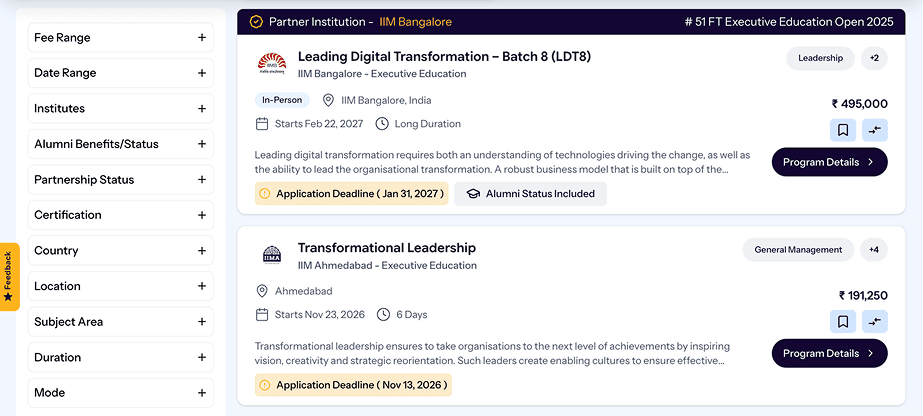
Researching different programmes is made easy with Echomind. The Echomind Explorer is a one-stop solution that helps you search, compare and shortlist programmes. Our website has more than 2000 programmes from prestigious schools like IITs, IIMs, ISB, and other leading global institutions. You can filter these programmes by fee, duration, mode and specialisation. Ultimately, the right executive programme is the one that aligns your learning investment with your professional goals. A recognised name may open the door, but the depth and relevance of the learning can determine what you do once you walk through it.
Share :