
At what career stage does an Executive Program make the most impact?

Share :

Most professionals sign up for executive education when their growth, promotions stall despite great work. The issue is usually a hidden skill gap, either in management or leadership, that they struggle to pinpoint on their own. These courses give them the clear business tools and strategic confidence needed to finally break through that ceiling. That’s why you must have seen colleagues enrolling in prestigious executive programmes. Some complete their course and immediately land a senior promotion. But then there are others who finish the exact same course, post their certificate, and still nothing changes.
Why does this happen?
The difference is rarely about intelligence or hard work. It all comes down to timing. An executive programme is not a magic fix for your career. Rather it acts as an accelerator. If you step on the accelerator at the wrong moment, you waste fuel. If you hit it when your career engine is warm and ready, you surge forward. Knowing your exact career stage helps you choose the right course at the right time.
The Four Distinct Career Pivot Points
Most professionals move through four major stages in their working lives. Each stage brings a completely different set of challenges, expectations, and learning needs.
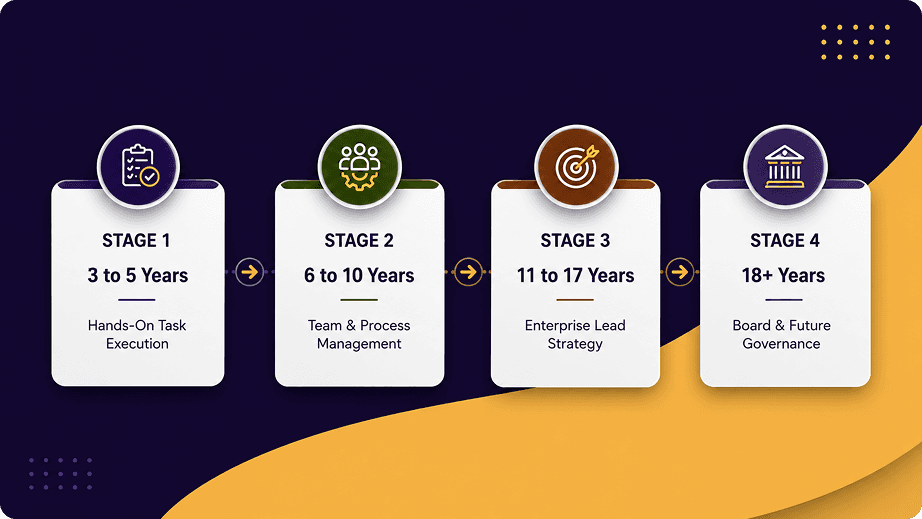
When you understand where you stand on this timeline, you can pick a course that delivers real, measurable results.
Stage 1: The Early-Career Specialist (3 to 5 years experience)
At this stage, you are focused on doing the work. You are building technical credibility, mastering daily tasks, and proving you are dependable. Enrolling in a broad executive leadership programme now usually falls flat. Why? Because you do not yet manage large budgets, set corporate policy, or lead big teams. Without practical context, high-level business strategy remains purely academic.
What works best at this stage:
Focused, short courses in specific functional skills like advanced data analytics, digital tools, or performance marketing.
Hands-on certifications that make you faster, sharper, and more efficient in your daily tasks.
Your main goal right now is functional mastery. Save general management programmes for later.
Stage 2: The Mid-Level Transition Point (6 to 10 years experience)
This is the first major turning point in your professional life. You are no longer judged solely on your personal output. You now lead teams, manage workflows, and coordinate with other departments. Many professionals hit a wall here. An engineer might struggle to read a profit-and-loss sheet. A marketer might not understand operational bottlenecks. An executive general management programme at this stage delivers an immediate return on investment. It breaks down departmental silos and teaches you how all parts of a company work together.
What works best at this stage:
Executive General Management Programmes (EGMP) lasting 6 to 11 months.
Accelerated leadership tracks that cover corporate finance, people management, and operations.
This training gives you the language to communicate across functions, helping you advance from Manager to Associate Director.
Stage 3: The Pre-C-Suite Leader (11 to 17 years experience) The "Golden Window"
This is where an executive programme delivers its highest career and financial impact.
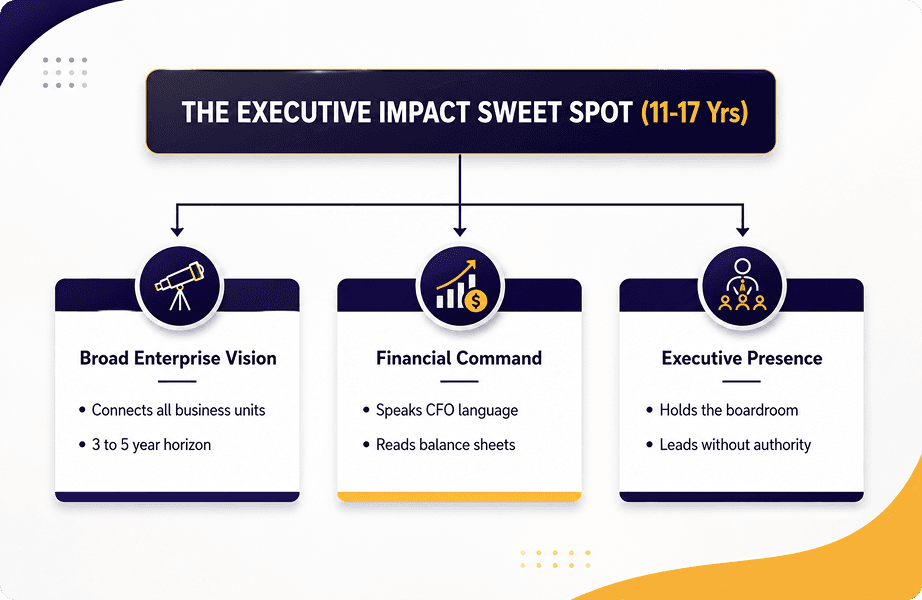
At this level, your technical background matters far less than your enterprise vision. You need to talk strategy with the CEO, debate numbers with the CFO, and manage organisational change. Taking a premier programme from an institution like an IIM or ISB provides the exact frameworks you need to step up.
What works best at this stage:
Senior Executive Leadership Programmes.
Advanced Management Programmes with residential campus immersion.
Courses focusing on business growth, financial strategy, and executive communication.
You leave these courses ready to step into VP, Senior VP, and CXO roles with proven confidence.
Stage 4: Senior Executives and Enterprise Leaders (18+ Years Experience)
When you reach the senior executive level, you do not take courses to learn standard business concepts. You already know how to run a company. At this point, executive learning serves two distinct purposes: staying ahead of industry disruption and benchmarking against top peers. You need to understand how emerging tech, generative AI, and new regulations affect your business model.
What works best at this stage:
Short, intensive masterclasses on board governance and corporate ethics.
Global executive immersion retreats.
Specialised programmes covering AI adoption and sustainable business strategy.
Here, the primary value comes from the room itself. You gain sharp insights by discussing macro trends with industry peers who face the exact same pressures.
Career Stage vs. Program Format vs. Expected Outcome
Experience Bracket | Core Career Need | Ideal Programme Format | Primary Outcome |
3 to 5 Years | Task mastery and tools | Short functional certifications (1 to 3 months) | Faster execution and domain expertise |
6 to 10 Years | Cross-functional fluency | General Management Programmes (6 to 11 months) | Transition from individual contributor to team lead |
11 to 17 Years | Enterprise strategy & finance | Senior Executive / Advanced Leadership tracks | Direct pathway from VP/Director to C-Suite |
18+ Years | Future-proofing & governance | C-Suite roundtables & short global immersions | Boardroom readiness and strategic vision |
Three Signs You Are Ready for an Executive Program Right Now
If you are unsure whether this is your moment to enroll, look for these three clear signals:
1. You have hit a functional ceiling
You are outstanding at your current job, but that excellence no longer translates into promotions. Senior management wants to see enterprise thinking before they hand you larger responsibilities.
2. Financial and strategy meetings feel intimidating
When leadership discusses capital allocation, risk management, or margin expansion, you feel out of your depth. You need structured training to join those conversations with authority.
3. You have real, messy problems to solve
The best time to learn business frameworks is when you can apply them to live workplace challenges on Monday morning. Real work context turns classroom theory into permanent capability.
When Is It Too Early (or Too Late)?
Timing mistakes can waste both time, money and energy.
It is too early when:
You have less than three years of experience and enroll in a senior strategy programme. You will struggle to contribute to cohort discussions, and recruiters will view the credential as premature.
It is too late when:
You wait until your skills become completely outdated or your industry declines. An executive certificate works best when building on active momentum, not as a last-minute rescue plan.
The Echomind Advantage: Timing Your Next Move
Finding a programme that matches your exact career stage should not require searching across dozens of different websites. Echomind Explorer brings executive offerings from top business schools like the IIMs, IITs, and ISB as well as International schools into a single dashboard. You can filter courses by required experience, syllabus depth, batch timings, and fee structures. Whether you need a mid-career management course or an advanced leadership track, Echomind helps you compare options side by side. You make your career investment with total clarity.
Moving Forward with Confidence
Executive education is not about collecting certificates to decorate a resume. It is about acquiring the right skills at the right moment to unlock your next career milestone.Take an honest look at your current career stage, spot your immediate skill gaps, and pick a programme that supports where you are heading next.
Share :