
Leadership vs Management: Which Skill Gap Is Holding Back Your Promotion?

Share :

Suppose Rajan has been a Senior Manager at a mid-sized FMCG company in Gurugram for 4 years. His numbers are spotless. Every quarter, without fail, he delivers. His team meets deadlines. His budgets never overshoot. His reporting is flawless. Yet last month, the VP role went to Priya. Priya, who joined two years after Rajan. Priya, who occasionally misses a detail or two but somehow always seems to be in the right room, saying the right things, at exactly the right moment. Rajan is baffled. His manager calls him "indispensable." His skip-level thinks he is "incredibly reliable." But nobody is promoting him.
This is not an uncommon story in Indian corporate life. It plays out in IT firms in Bengaluru, banks in Mumbai, manufacturing companies in Pune, and startups in Hyderabad every single quarter. And in most of these cases, the real reason the promotion stalled is not performance. It is a skill gap. Specifically, either a leadership gap or a management gap. The problem is that most professionals cannot tell which one is holding them back.
Managing the Present vs Leading the Future
Before you can diagnose your gap, you need to know what you are actually measuring.
Management is about the present. It is about keeping things running smoothly, on time, and within budget. A good manager builds systems, removes bottlenecks, tracks performance, and ensures that the day to day engine of a team or department does not stall. Think of management as keeping the train running on time.
Leadership is about the future. It is about deciding where the tracks should go. A good leader sets direction, builds alignment across teams, influences stakeholders, navigates ambiguity, and inspires people to move toward something they cannot yet fully see.
Neither is superior. Both are essential. And here is the part that most professionals miss: both are completely learnable. Neither is a personality trait you are born with or without. The deeper truth is this. Promotions, especially beyond the Senior Manager level in Indian organisations, are not rewards for past performance. They are calculated bets on future capability. The question a promotion committee is really asking is not "has this person delivered?" It is "can this person operate at the next level?" That is an entirely different question, and it demands an entirely different answer.
The Leadership Gap: The Star Executor Who Cannot Lead
This is one of the most common promotion blockers in Indian corporate culture. The star executor is excellent at what they do. They are dependable, thorough, and highly functional. Upper management loves them in their current role, which is precisely why they never get moved out of it. Being called "indispensable" sounds like a compliment. In career terms, it is often a trap. Executive committees do not promote people they cannot afford to lose from their current role. They promote people who have already demonstrated they can operate at the level above.
If you have a leadership gap, you will likely recognise some of these signs in yourself. You are excellent one on one but struggle to rally cross-functional teams where you have no direct authority. You spend most of your day on task delegation and operational problem solving rather than thinking about strategy or direction. Your work history is full of strong functional achievements but relatively few high-visibility moments where you influenced a significant organisational decision. You find high-stakes meetings with senior stakeholders uncomfortable, and you tend to default to data and process when the room actually wants vision and conviction.
The leap from Senior Manager to Director or VP in India is rarely a technical one. It is a presence one. It is about whether you can walk into a room of senior stakeholders and be taken seriously as someone who thinks at the next level, not just executes at the current one.
This is exactly where Explorer by Echomind becomes relevant. Rather than leaving you to browse through hundreds of courses hoping something fits, Explorer shortlists high-impact programmes specifically targeting executive presence, strategic persuasion, corporate governance, and cross-functional leadership, matching your current profile to the precise credential that bridges your specific gap.
The Management Gap: The Visionary Leader Who Cannot Manage
Now meet the flip side. This is the person everyone finds inspiring. They give brilliant presentations. They can read a room. They connect with people effortlessly and paint a compelling picture of where things could go. Junior team members love working for them. But their projects are perpetually late. Their budgets quietly balloon. Their teams burn out because nobody is quite sure what is happening operationally on any given week. Their direct reports respect their energy but spend a lot of time privately firefighting the chaos underneath it.
This profile also hits a ceiling, and in Indian corporate environments it often hits it hard. No board, no CFO, and no promotions committee will hand over a significant P&L, a large operational budget, or a multi-city team to someone they do not trust to run a tight, predictable ship. Vision without execution is exciting in a TED Talk. It is a liability in a boardroom.
If you have a management gap, these signs will feel familiar. Your projects regularly miss deadlines, drift beyond their original scope, or come in over budget without a clear explanation of why. Your team is engaged in terms of culture but unclear about priorities, accountability, or what success actually looks like week to week. When senior leadership asks you for a structured financial breakdown or an operational plan with clear milestones, you find yourself reaching for someone else to put it together.
Echomind Explorer maps profiles like this to targeted management development programmes, covering corporate finance, advanced operations, scaling frameworks, and P&L management, the specific, structural skills that build organisational trust and signal boardroom readiness.
The Promotion Matrix: Where Do You Sit?
It helps to see this clearly. Think of a simple grid with management skill on one axis and leadership skill on the other.
If you are low on both, you are operating as a Specialist. Technically strong, individually valuable, but not yet on a leadership track. This is a fine place to be early in a career. It is a concerning place to stay past your mid-thirties.
If you are high on management but low on leadership, you are the Super-Supervisor. This is Rajan. Operationally excellent, consistently reliable, but execution-bound. Organisations depend on you but do not picture you at the next level.
If you are high on leadership but low on management, you are the Maverick. Inspiring, visible, and full of ideas, but not yet trusted with scale. Organisations like you in the room but hesitate to give you the keys.
If you are high on both, you are a C-Suite Candidate. Balanced, credible, and promotion-ready. This is the quadrant every mid-career professional in India should be actively moving toward.
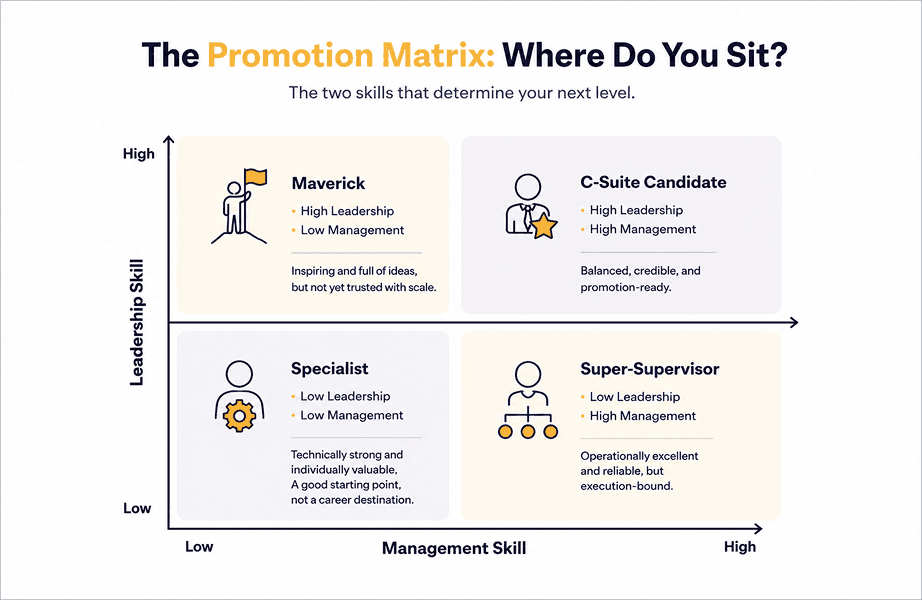
Explorer by Echomind is built specifically to help professionals shift from the Super-Supervisor or Maverick quadrants into C-Suite Candidate territory, through targeted, credible upskilling rather than hoping the gap closes on its own over time.
What Promotion Committees in 2026 Actually Look For
Here is the honest reality of how promotions work in Indian organisations today, across IT services, banking, consulting, consumer goods, and beyond. Nobody gets promoted to a senior leadership role purely because they worked the hardest or met every target. At the Director, VP, and C-Suite level, three things quietly gatekeep every promotion decision.
Stakeholder management is the ability to build and maintain credibility with people above, beside, and below you in the organisation, especially those you have no authority over. Executive presence is the ability to walk into a high-stakes conversation and be taken seriously as a strategic thinker, not just a functional doer. Cross-functional influence is the ability to drive outcomes across teams and departments that do not report to you.
These three skills are almost never developed by accident. They are learned. And in a competitive Indian corporate environment, where professionals increasingly hold international certifications and executive education credentials alongside their work experience, structured learning from credible institutions is one of the clearest signals a promotion committee can see that you are already thinking at the next level.
How to Diagnose Your Personal Bottleneck
Before you choose what to learn, you need to be honest about where you actually sit. Ask yourself these questions, and answer them as you are, not as you would like to be.
Do senior leaders come to you for a safe pair of hands, or for strategic direction? When your team misses a target, is it usually because of disorganised workflows, or because people were not motivated or aligned? Can you explain the three-year strategic direction of your department without looking at a slide? When you are in a room with people two levels above you, do you feel like a peer or do you feel like a guest? Do you know your department's P&L well enough to defend every line of it?
Your answers will point clearly toward one gap or the other. And that clarity is where the work begins.
Closing Your Gap with Echomind Explorer
A two-year full-time MBA is the right answer for some people at some stages of a career. For a busy mid-career professional in India who has identified a specific skill gap and needs to close it without stepping away from a full-time role, it is often too broad, too expensive, and too disruptive. Targeted executive credentials from credible institutions, chosen to address your specific gap, are frequently more effective and more visible to promotion committees than a general qualification.
If you have a leadership gap, Explorer by Echomind filters programmes in executive presence, strategic leadership, digital transformation, and corporate governance, and matches them to your current level, industry, and schedule.
If you have a management gap, Explorer maps your profile to premier short-term credentials in P&L management, advanced financial decision-making, operational scaling, and structured execution frameworks.
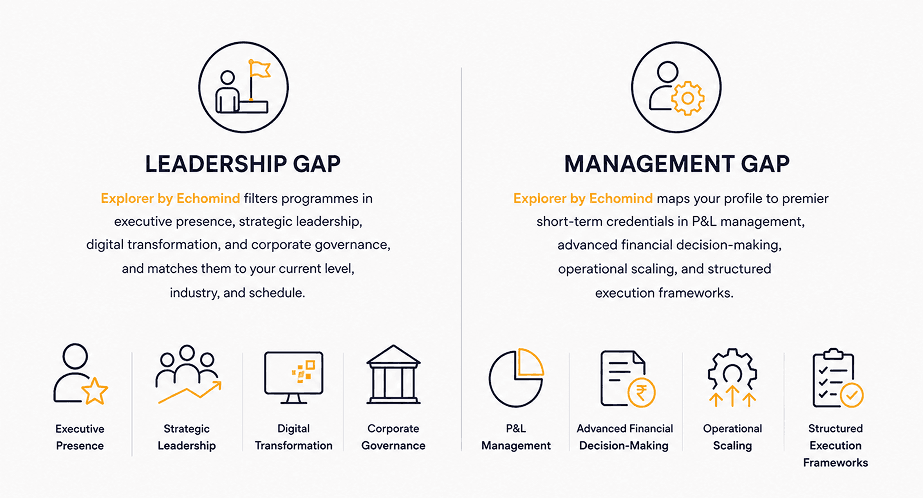
The goal is not more learning for its own sake. It is the precise, targeted credential that closes your specific gap and signals readiness to the people who decide what comes next in your career.
The Honest Bottom Line
A promotion is not a reward for past performance. It is won when you can already demonstrate that you operate at the next level before the title is handed to you. The good news is that neither gap, leadership nor management is permanent. Both are learnable. Both can be closed deliberately, with the right structured credential, from the right institution, chosen for how precisely it addresses what is actually missing from your profile.
That is exactly what Echomind Explorer is built to do. Not to overwhelm you with options, but to look at where you are, identify what is standing between you and the next level, and match you to the programme that closes that specific gap. Open Echomind Explorer, find your gap, and take the precise step that moves you from where you are to where you should already be.
Share :