
Why the Same Executive Programme Costs Different Amounts on Different Platforms - And What That Means for You

Share :

You are ready to invest in an executive programme from a top business school. You open three tabs. On the institution's direct portal, the fee is ₹3.5 lakh. On a major edtech platform, the exact same course shows as ₹3.8 lakh. On a third aggregator, it is listed at ₹3.25 lakh.
Same faculty. Same curriculum. Same final certificate. So why three different price tags?
When you are spending serious money on executive education, this gap causes instant hesitation. Is the cheaper option a scam? Is the expensive one charging a hidden markup? Or are you missing crucial fine print? This confusion is real, common, and completely justified. Before committing a significant portion of your professional development budget, you need to understand how executive education pricing actually works.
This Is More Common Than You Think
A price gap between ₹10,000 and ₹50,000 for the exact same executive programme is standard practice in the industry. It happens across elite Indian institutes like the IIMs and ISB, as well as global business schools. This is not a technical glitch or a dodgy marketing trick. It is simply how modern executive education distribution operates behind the scenes.
Most working professionals assume executive education works like a traditional college admissions office. In that model, one central authority sets one fixed price.
However, modern professional learning functions far more like the airline or hotel industry. The core product stays identical, but the routes to purchase it are varied. Most professionals only notice this when they compare platforms side by side.
How Executive Programmes Actually Get Distributed
To understand the price tags, you must understand the distribution ecosystem. Premier universities rarely manage the entire end-to-end sales, technology, and support infrastructure for executive cohorts. Instead, they partner with third-party channels to reach working professionals.
These channels include:
Direct University Portals: The institute's own website and executive education desk.
EdTech Distribution Platforms: Large education companies that host the program on their learning management systems.
Aggregators and Marketplaces: Discovery portals that connect learners with multiple institutional offerings.
Corporate L&D Networks: Enterprise partners who distribute programmes directly to HR teams.
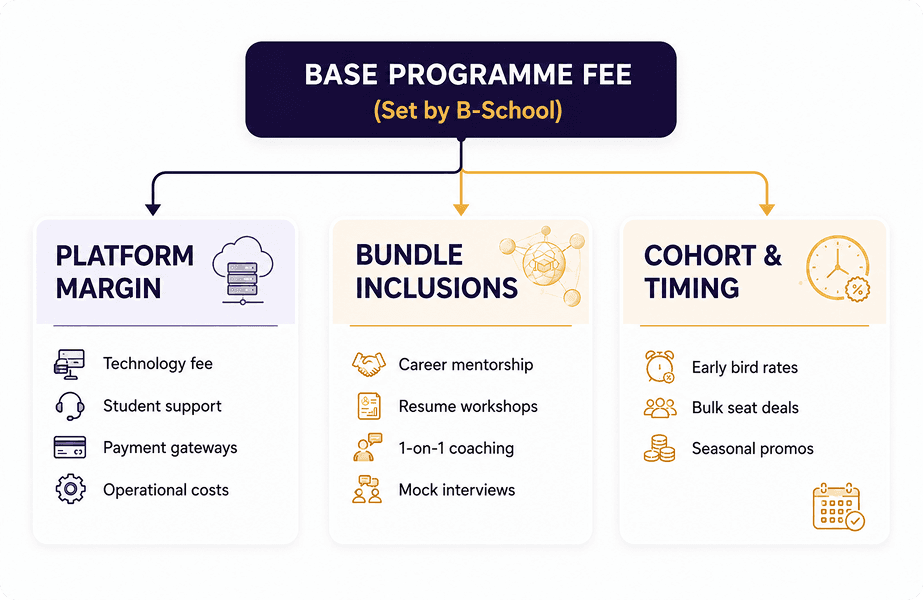
Each channel operates under a unique commercial agreement with the university. Some platforms buy cohort seats in bulk at wholesale rates. Others charge a commission on every seat sold. Some platforms add custom services on top of the base course, while others pass operational savings back to the consumer. These distinct backend deals lead directly to different prices on your screen.
Five Reasons the Price Is Different on Different Platforms
When you see a price mismatch for the same executive programme, it usually comes down to five specific factors.
1. Platform Margins
Some aggregators and edtech portals add a service fee to the university's base price. They justify this markup by providing custom user interfaces, dedicated account managers, or flexible payment gateways. You are paying extra for the convenience and technology of that specific platform.
2. Early Bird and Cohort-Specific Pricing
Pricing can shift based on when a platform secures its seat allocation. Platform A might still offer early-bird rates for an upcoming batch. Platform B may have filled its early allocation and moved to standard pricing. The same programme can cost less in January than in March simply due to batch timing.
3. Bundle Inclusions
This is the most common reason for a price gap. One platform lists the base programme fee alone. Another lists a higher price that includes capstone project mentorship, 1-on-1 career coaching, or offline networking events. The price difference is rarely about the core lectures; it reflects the extra services wrapped around them.
4. Corporate vs Retail Pricing
Platforms catering primarily to enterprise HR teams often secure corporate volume discounts. Occasionally, these platforms allow individual learners to access those lower enterprise rates. A consumer-focused platform lacking these corporate ties must sell at full retail price.
5. Independent Promotional Subsidies
Edtech platforms frequently run their own promotional campaigns to hit monthly enrollment targets. The university keeps its base fee fixed, but the platform absorbs a discount out of its own marketing margin to win your business over a competitor.
What the Price Difference Does Not Tell You
A lower price on one platform does not mean a compromised educational experience. Conversely, paying a premium on a different platform does not guarantee better learning. Regardless of where you complete your transaction, certain core components remain strictly identical:
The Academic Curriculum: The syllabus, modules, and assignments are governed entirely by the partner university.
The Teaching Faculty: You learn from the exact same professors, guest lecturers, and industry practitioners.
The Final Qualification: Your certificate or credential comes directly from the business school, bearing their official seal.
The Brand Value: Employers evaluate the reputation of the awarding university, not the platform where you paid your invoice.
The core product never changes. Only the surrounding service layer varies.
What the Price Difference Does Tell You
A higher price tag on a specific platform should prompt direct, critical questions before you enter your credit card details:
What specific extra services am I getting for this price gap?
Does this higher fee include career placement assistance or executive coaching?
Are those extra services actually useful to my current career stage?
Am I simply paying for another company's expensive marketing campaign?
If a platform charges ₹40,000 extra for career services you do not need, that higher price offers zero real value to you.
How to Actually Compare Before You Pay
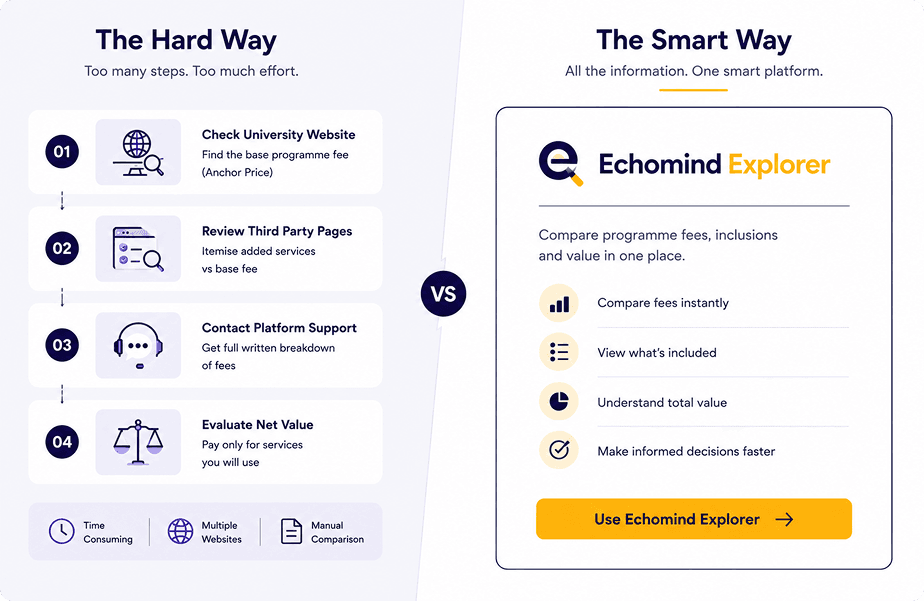
Comparing programme fees across platforms manually is time-consuming, tedious, inconsistent and an exhausting procedure. Most professionals spend hours on it and still are not sure they got it right.
Echomind Explorer does it for you instantly! Explore over 1,000 executive programmes from IIMs, IITs, ISB, and leading global institutions. Search by domain, duration, budget, or career goal. Compare programmes side by side, view complete fee breakdowns, and see exactly what each price tag includes, all in one place, in seconds. No chasing admissions teams or reading fine print across 5 different websites.
And it goes further than just fees. Explorer matches programmes to your profile, your experience level, and where you want to go next. This helps you in not just finding the cheapest option, but the right one too.
What This Means If You Are Buying Through Your Company
If your employer is funding your education, never pay retail prices on consumer websites. HR and Corporate L&D departments frequently hold master service agreements with major learning networks. These enterprise contracts grant access to subsidised rates, fee waivers, and flexible payment terms that are never published on public landing pages. Before booking any executive programme directly, ask your internal L&D team if your company has an active partnership with the institute or a preferred distribution portal.
The Echomind Advantage
This is precisely the problem Echomind Explorer is built to solve. Comparing scattered course pages, buried fee structures, and varied service bundles wastes valuable time. Echomind Explorer simplifies this process by bringing over 1,000 executive programmes from 50+ top global business schools into one unified dashboard. Echomind tracks programme fees with complete transparency. You can compare courses side by side, view clear fee breakdowns, and see exactly what each price tag includes. Whether you are evaluating short masterclasses or long-duration executive certifications, Echomind eliminates hidden costs.
You make major career investments based on clear facts, not missing information.
The Bottom Line
The price differences you see across platforms are real, they are explainable, and they are navigable. The programme itself does not change based on where you buy it. What changes is the information, the support, and the transparency you get along the way.
Do not assume the highest price guarantees superior quality, or that the lowest price is a trap. Verify the base fee, check the bundled features, and purchase with complete clarity.
Ready to explore top executive programmes with transparent pricing? Use Echomind Explorer to compare fees, schedules, and course details side by side today.
Share :