
The Upskilling-Engagement Loop: Why Employees Who Learn Stay Longer

Share :

Picture 2 employees who joined your company on the same day. One gets a learning path within her first month. She picks up a new skill, then another. Her manager notices and gives her a stretch project. The other employee gets onboarded, then left alone. No path, nudge or growth. Some months later, you can probably guess who is still on your team.
This is not a coincidence. It is a loop. Learning builds confidence. Confidence builds engagement. Engagement builds loyalty. And loyalty feeds back into more learning, because engaged employees ask for growth. HR leaders who understand this loop stop treating upskilling as a cost centre. They start treating it as a retention engine.
This piece breaks down why the loop exists, what the data says, and how leaders can build it deliberately rather than hope it happens by accident.
The Anatomy of the Upskilling-Engagement Loop
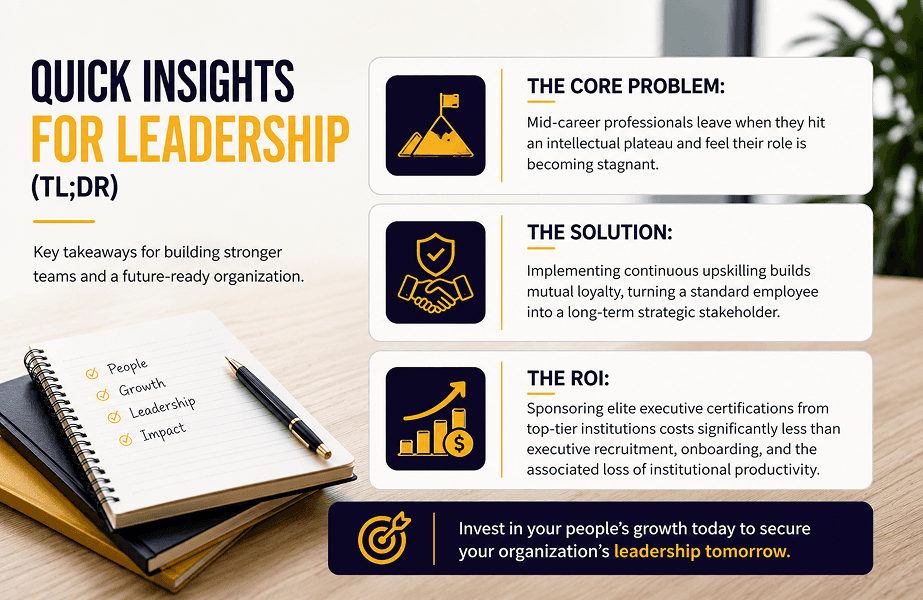
To understand why learning drives retention, we must look at the psychological shifts that occur when an organisation funds an employee's professional development. The loop operates as a virtuous cycle where investment yields engagement, and engagement drives long-term retention.
When an enterprise sponsors an employee to pursue a premium credential, such as a specialised executive certificate from an IIM, ISB, or XLRI - the immediate benefit extends far beyond the curriculum. The professional experiences an instant boost in confidence and validation. They are no longer just executing routine tasks; they are mastering macro enterprise strategy and advanced data analytics.
This sense of personal development directly fuels operational impact. Because the executive is acquiring cutting-edge frameworks over the weekend, they immediately apply those insights to active corporate challenges on Monday morning. The employer reaps the rewards of a highly optimised problem-solver, while the employee feels a profound sense of institutional equity. They choose to stay longer because their personal brand and career trajectory are actively expanding within the organisation's walls.
Why Static Roles Breed Attrition
The traditional corporate agreement, where an employee exchanges a fixed skill set for a steady paycheck, is fundamentally broken. In an era shaped by rapid technological shifts, predictive modeling, and changing market dynamics, skills have a remarkably short shelf life. Mid-career professionals are acutely aware that sitting still is the ultimate career risk.
According to global talent trends tracked in the LinkedIn Workplace Learning Report, organisations that prioritise internal mobility and robust learning ecosystems enjoy significantly higher employee retention rates compared to those with static development paths. When a professional with 7 to 12 years of experience hits a structural growth plateau, a distinct pattern emerges:
Intellectual Stagnation: The day-to-day execution becomes repetitive, and exposure to strategic enterprise decision-making stalls.
Anxiety Over Market Relevancy: The professional sees peers mastering modern tech governance or corporate finance frameworks, leading to an increasing fear of being left behind.
Disengagement: Without a clear internal development roadmap, the employee detaches from company goals and becomes highly receptive to external recruiter outreach.
Traditional, slow-moving corporate training videos or basic learning management systems (LMS) fail to solve this problem. Experienced managers do not want generic corporate checkboxes; they desire structured, high-impact credentials that hold genuine weight in the broader industry.
Brand Value and Autonomy: What Modern Professionals Actually Want
To build a retentive learning culture, companies must align their Learning & Development (L&D) strategies with the personal branding goals of their top talent. Modern professionals care deeply about external prestige and career autonomy.
When evaluating an upskilling path, a senior manager looks for institutional pedigree. Gaining access to executive cohorts from world-class domestic powerhouses like ISB or IIM, or global institutions such as Harvard, MIT, Stanford, Oxford, and INSEAD, provides immense personal validation.
Displaying a verified executive milestone on LinkedIn satisfies a professional's natural desire for market visibility. When an employer sponsors this level of personal equity, it creates a powerful psychological contract. The employee doesn't feel the need to look elsewhere for external validation because their current organisation is actively positioning them as a future-ready leader.
The Financial Case: L&D Sponsorship vs. The Cost of Re-Hiring
Many CFOs hesitate to fund premium executive training due to a classic corporate dilemma:
"What if we train our people and they leave?" The more appropriate question leadership should ask is: "What if we don't train them and they stay?"
The financial metrics compiled by SHRM Analytics consistently show that replacing a mid-to-senior-level leader is an incredibly expensive process. The true cost of executive attrition involves recruitment fees, onboarding expenses, and the intangible loss of team momentum and institutional knowledge.
Evaluative Metric | Corporate Sponsorship Path | Executive Attrition & Re-Hiring |
Direct Financial Outlay | ₹3 Lakhs – ₹12 Lakhs (Tier-1 Executive Certification) | 1.5x to 2x the executive's annual base salary in total replacement costs. |
Operational Continuity | Disruptions are entirely avoided; learning runs in parallel with daily work execution. | 3 to 6 months of lost productivity, unmanaged projects, and disjointed team dynamics. |
Institutional Impact | Immediate implementation of fresh corporate frameworks and advanced strategies. | Onboarding lag time before a new hire fully understands company workflows. |
Cultural Signal | Signals across the enterprise that top talent is highly valued and actively supported. | Creates internal instability and can trigger secondary departures within teams. |
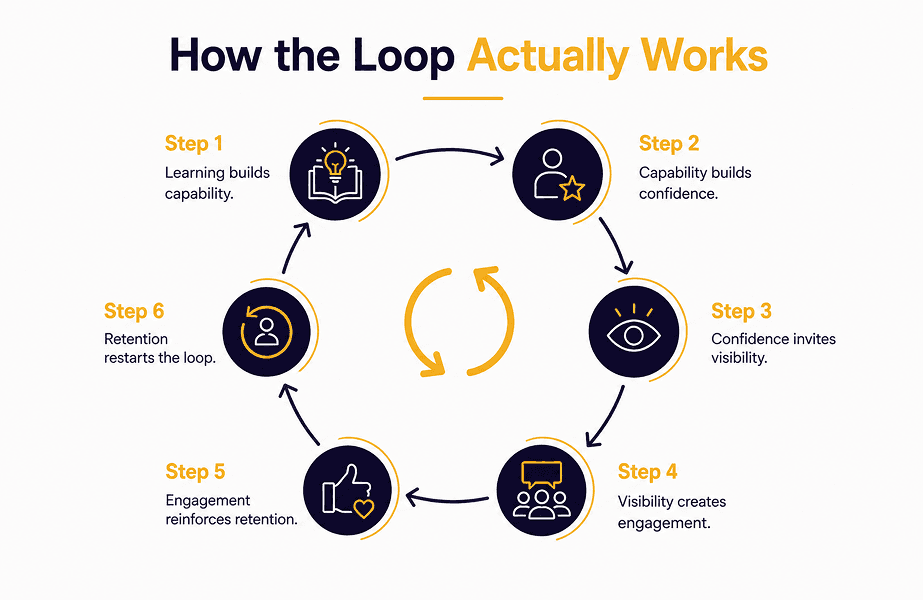
How the Loop Actually Works
Let us name the mechanism clearly, because executives respond better to logic than to buzzwords.
Step 1: Learning builds capability.
An employee picks up a new skill relevant to their role or a future one. This is the most visible part of upskilling, but it is only the entry point.
Step 2: Capability builds confidence.
Once someone has practised a skill, even briefly, their sense of competence rises. This shows up quickly in day to day work, not just in performance reviews.
Step 3: Confidence invites visibility.
Confident employees raise their hand for stretch projects. Managers notice. This is also where internal mobility starts to take shape, because visible employees get considered for new roles.
Step 4: Visibility creates engagement.
Being seen and valued is one of the strongest predictors of engagement. Employees in internal mobility programmes report thirty percent higher engagement scores than those who stay static in one role.
Step 5: Engagement reinforces retention.
Engaged employees rarely browse job boards. They are too invested in what they are building.
Step 6: Retention restarts the loop.
Long tenured employees accumulate institutional knowledge. They become mentors. Mentorship itself is a learning intervention, which feeds the cycle again from a new angle.
Why Most Organisations Break the Loop Early
If the loop is this powerful, why do so few companies benefit from it? The honest answer is that most upskilling investment is poorly targeted.
Recent research found that only 31% of organisations are actively investing in reskilling and upskilling, and just 16% plan to prioritise internal mobility, despite it being the single largest lever for improving retention. Even fewer, only 7%, intend to implement a common skills taxonomy, which is a prerequisite for any of this to function at scale.
There is also a participation problem once programmes exist. Only 30% of organisations see more than half their employees actively engaging with upskilling programmes, and 31% see fewer than one in four employees developing new skills. A learning platform that nobody uses cannot start the loop, regardless of how well designed the content is.
The pattern across this research is consistent. 70% of organisations are losing the retention battle while spending heavily on programmes they believe are addressing it. They are investing in the wrong layer. Job postings and exit interviews treat the symptom. Skills visibility, career pathing, and manager activation treat the cause.
What CHROs and HR Leaders Should Actually Do
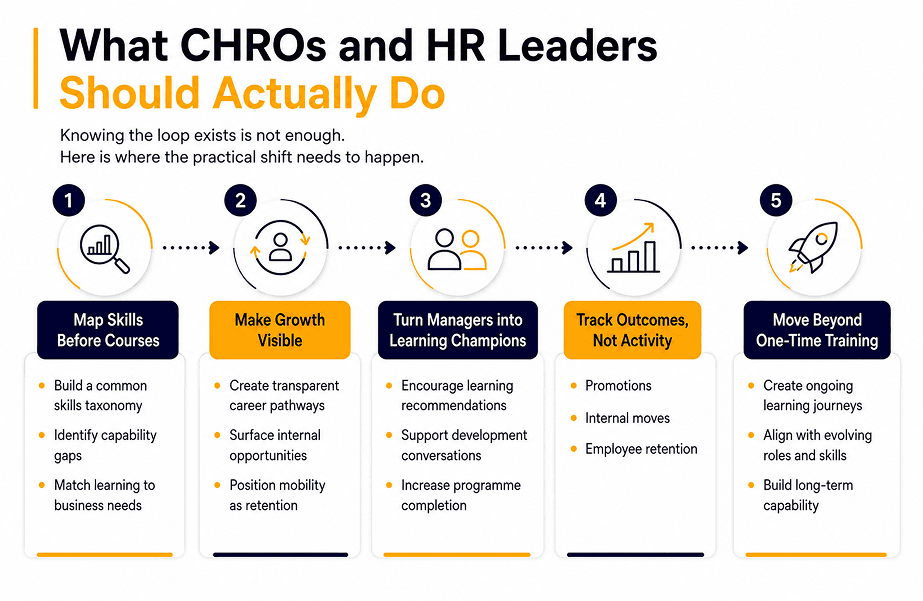
Knowing the loop exists is not enough. Here is where the practical shift needs to happen.
Map skills before you map courses
A common skills taxonomy lets you see gaps clearly and match people to opportunities. Without it, learning becomes guesswork.
Treat internal mobility as a retention strategy, not an HR side project
Make it visible, searchable, and genuinely accessible. Hidden opportunities do not retain anyone.
Activate managers, not just platforms
A learning system without manager buy-in becomes shelfware. Managers who actively recommend learning paths see far higher completion rates.
Measure engagement and retention together
Course completions and login rates feel reassuring, but they say little about real impact. Track whether learning correlates with promotion, mobility, and tenure.
Make learning continuous, not event based
A single onboarding module will not sustain a five year employee. Build pathways that evolve as roles and skills shift.
Conclusion: Future-Proofing Your Talent Architecture
In today's highly competitive corporate ecosystem, professional development is no longer just a perk listed in a hiring brochure; it is a vital mechanism for retention. Mid-career professionals will continue to seek out mastery, prestige, and career growth. If they cannot find those opportunities within your organisation, they will inevitably find them with a competitor.
By embracing the Upskilling-Engagement Loop, businesses can protect their talent architecture from attrition, build a resilient leadership pipeline, and turn learning into a major competitive advantage.
Ready to transform your enterprise retention strategy? Whether you are a corporate leader looking to structure premium executive paths for your teams or a senior professional aiming to accelerate your career trajectory, navigating the upskilling market requires clear direction.
Share :
Frequently asked questions (FAQs)
For any unanswered questions, reach out to our support team via contact us page or email. We'll respond with-in a day to assist you.