
The Skill Stack That Gets You to CXO: What Board Members Look for Beyond Technical Expertise

Share :

Most professionals reach the Director or VP level through functional mastery. They know their domain inside out, deliver consistently, and build a reputation for reliability. Then the C-Suite comes into view. And the rules change completely. The skills that carried you to where you are now are not the same skills that will take you to where you want to go. This is not a comfortable truth, but it is an important one. And the professionals who understand it early are the ones who actually make the leap.
Why Technical Expertise Stops Being Enough
Every CXO candidate walking into a board conversation has strong technical credentials. This is the assumption. It is the entry ticket, not the differentiator.
What board members are actually evaluating is something harder to quantify and far more difficult to fake. They are asking whether this person can lead the organisation, not just a function. Whether they can hold a room of senior stakeholders, think in years, not quarters. Whether they understand the business well enough to make decisions with incomplete information and still be right more often than they are wrong.
Technical expertise answers none of these questions. Which is why so many highly capable professionals plateau just below the level they deserve to be at.
Metric / Dimension | Functional VP Level | CXO / Board Level |
Primary Horizon | Quarters & Annual Targets | 3–5 Year Strategic Trajectory |
Core Focus | Operational & Functional Excellence | Enterprise-Wide Value Creation |
Financial Lens | Departmental Budget Allocation | Balance Sheet, Liquidity & Capital Allocation |
Influence Mode | Direct Authority & Team Management | Cross-Functional Alignment & Board Stewardship |
The 5-Part Skill Stack Boards Actually Evaluate
Strategic Thinking at an Organisational Level
The difference between a VP and a CXO is not seniority. It is the altitude at which they think. A VP optimises their function. A CXO thinks about how every function connects, where the organisation is going, and what needs to be true for it to get there. Strategic thinking at this level means understanding market dynamics, competitive positioning, long-term resource allocation, and how decisions made today shape outcomes 3 years from now. This is a learnable skill. But it requires deliberate practice and structured exposure and not just time in the job.
Financial Acumen Beyond Your Own Budget
Board members trust CXOs who can speak fluently about the entire financial health of the organisation. Not just their departmental budget. The full picture. This means understanding how to read and interpret financial statements. How to assess organisational performance through key ratios and metrics. How to connect operational decisions to profitability, liquidity, and risk. A CXO who cannot hold a detailed conversation with the CFO is a CXO who loses credibility in the room very quickly.
For professionals who have spent their careers in non-finance functions, this is often the single biggest gap between where they are and where they want to be.
Stakeholder Management and Executive Presence
There is a specific kind of credibility that board members look for in a CXO candidate. It is not about being the loudest voice or the most polished presenter. It is about whether you can walk into a high-stakes conversation with people above, beside, and well below you in the organisation and be taken seriously as someone who thinks at the right level.
Executive presence is built on clarity of thought, confidence in ambiguity, and the ability to listen as well as you speak. It is how you carry yourself in a room where the decisions are real and the consequences are significant. And it is something that most professionals have never been formally taught.
Cross-Functional Leadership
CXOs do not lead functions. They lead organisations made up of many functions, most of which do not report to them directly.
The ability to drive outcomes across teams, departments, and geographies, without relying on authority, is one of the most consistently underestimated skills on the path to the C-Suite. It requires political intelligence, the ability to build genuine alignment, and the patience to bring people with you rather than pushing them forward.
Professionals who have spent their careers inside a single function often discover this gap only when they are already in a senior role. By then, closing it takes considerably more effort.
Business Governance and Ethical Leadership
Boards are paying closer attention than ever to how leaders make decisions, not just what decisions they make. ESG frameworks, corporate governance structures, regulatory awareness, and ethical accountability are no longer peripheral concerns. They are central to how organisations are evaluated by investors, regulators, and the public.
A CXO who understands governance, who can navigate corporate law, align sustainability with strategy, and lead with accountability, is a CXO who makes the board's job easier. That matters more than most people realise when promotion decisions are being made.
The Ability to Lead Through Change
Organisations are not static. Markets shift. Technologies disrupt. Business models that worked brilliantly three years ago can become liabilities almost overnight.
Board members want CXOs who are not just comfortable with change but who can lead organisations through it without losing the team along the way. This means understanding change management frameworks, knowing how to communicate a new direction without creating panic, and having the personal resilience to stay steady when everything around you is moving fast.
The Gap Nobody Talks About Honestly
Here is what most career advice gets wrong about the CXO path. It treats the gap between VP and C-Suite as a matter of waiting long enough or performing well enough in the current role. It is neither. The gap is a skills gap. A specific, identifiable, closable gap between the capabilities you have built in your current role and the capabilities the board is looking for in the role above it.
The professionals who close that gap fastest are the ones who name it clearly and address it deliberately. Not by hoping the next project will stretch them in the right direction. But by seeking structured learning that is specifically designed to build the skills boards actually look for.
Executive education programmes built for senior professionals, the kind that cover strategic management, financial leadership, organisational behaviour, governance, and cross-functional decision-making in an integrated curriculum. These exist precisely for this moment in a career. They are not a shortcut. In fact, they are a structured bridge between where you are and where you are trying to go.
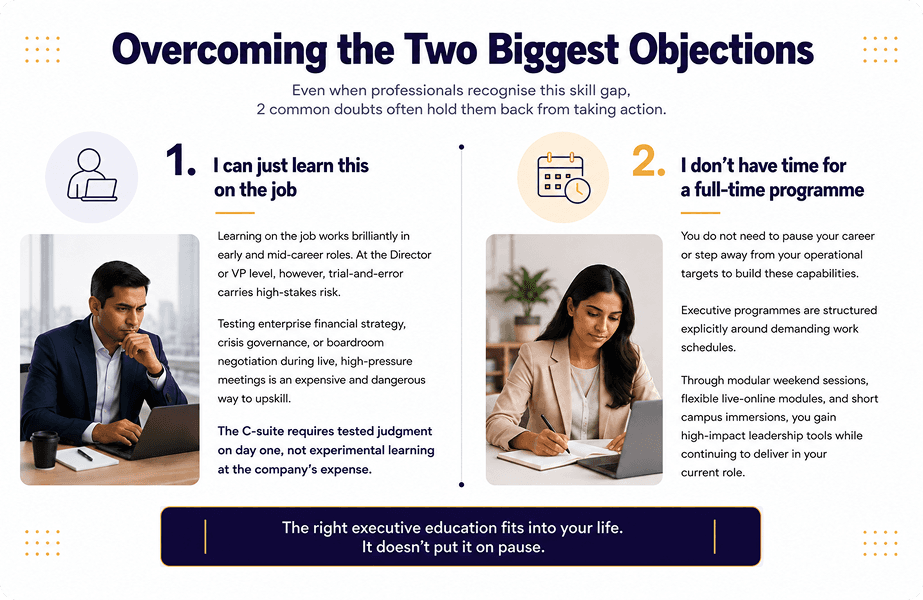
Overcoming the Two Biggest Objections
Even when professionals recognise this skill gap, 2 common doubts often hold them back from taking action.
1. I can just learn this on the job - Learning on the job works brilliantly in early and mid-career roles. At the Director or VP level, however, trial-and-error carries high-stakes risk. Testing enterprise financial strategy, crisis governance, or boardroom negotiation during live, high-pressure meetings is an expensive and dangerous way to upskill. The C-suite requires tested judgment on day one, not experimental learning at the company's expense.
2. I don't have time for a full-time programme - You do not need to pause your career or step away from your operational targets to build these capabilities. Executive programmes are structured explicitly around demanding work schedules. Through modular weekend sessions, flexible live-online modules, and short campus immersions, you gain high-impact leadership tools while continuing to deliver in your current role.
What This Means for You Right Now
If you are at Director or VP level and the C-Suite is the honest goal, start by asking yourself which of these skills you can demonstrate today with real evidence. Not theoretically. Not in terms of potential. With actual examples from your current role. The ones where the answer is unclear are your gaps. And gaps, when named clearly, become plans.
The board is not looking for the most experienced person in the room. They are looking for the most ready one. Readiness is built deliberately, not accumulated passively.
Identified your skill gaps? Don't leave your transition to chance. Use Echomind Explorer to compare premier executive general management and leadership programmes across top business schools, side-by-side, with complete fee and curriculum transparency.
Share :