
The Right Way to Ask Your Company to Sponsor Your Executive Programme

Share :

For mid-level professionals looking to strengthen their capabilities, an executive programme can be highly beneficial. It can help working professionals in upskilling without stepping away from their careers. The goal is to strengthen leadership skills, understand AI-driven workflows, develop strategic thinking, and prepare for larger roles. It makes professional development more structured and relevant to current workplace demands.
However, paying for an executive programme can be a significant personal investment. A practical alternative is to ask your company to sponsor it if it aids your current responsibilities or business priorities. But how do you pitch to your company that you want them to sponsor your executive education? The real challenge lies in knowing how to make that request. A sponsorship request should not sound like a personal request for financial assistance. It should demonstrate how the programme creates value for both you and the organisation. Demonstrate how the programme aligns with company vision, drives business growth, and empowers you to deliver better results.
Show That This Benefits Everyone Involved, Not Just You
Establish a strong connection between the programme, your role, and your company’s needs. This makes it easy for your manager, and HR team to evaluate your request for sponsorship. Frame the executive education as a strategic capability-building investment rather than an individual perk.
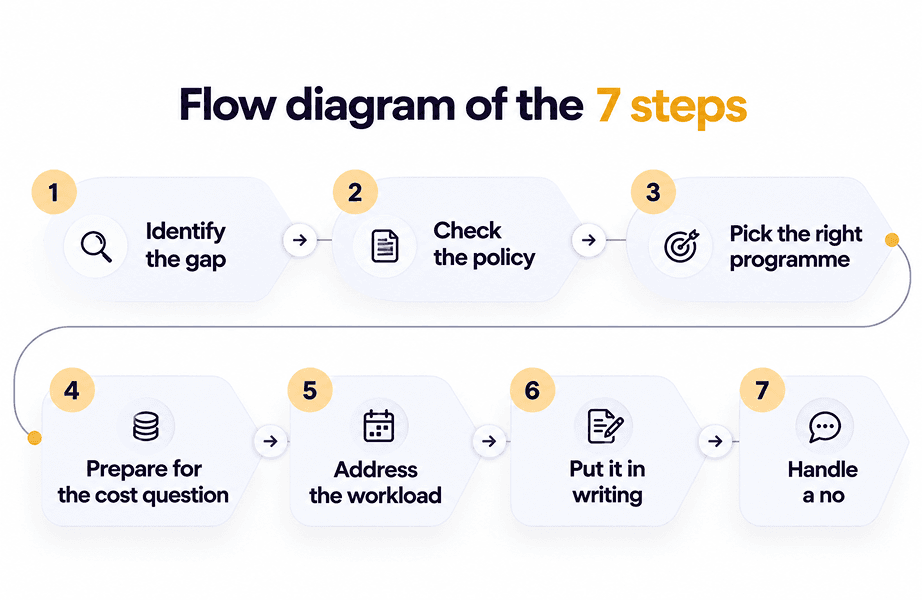
Start With Why the Programme Matters to Your Role
Before you approach the management, identify the specific professional gap you want the executive programme to address. Instead of starting with how this programme will help your career, start by describing the challenges you currently face at work. You need to establish a business case for the company to sponsor your learning.
Describe the challenges:
Are you taking on responsibilities that require stronger strategic thinking?
Are you managing cross-functional teams?
Does your role increasingly involve data, automation, or AI tools?
Are you expected to make decisions using business analytics?
Your executive programme should have a focus on these requirements. Your objective is to shift from “I want to learn this” to “this will help me perform a specific part of my job in a better way.”
Choose an Executive Programme That Has Workplace Relevance
Not every programme will make an equally strong sponsorship case. When selecting an executive education programme, look beyond the institution's name or certificate. Consider how closely the curriculum matches the capabilities your organisation needs and whether the learning can be applied to your current responsibilities.
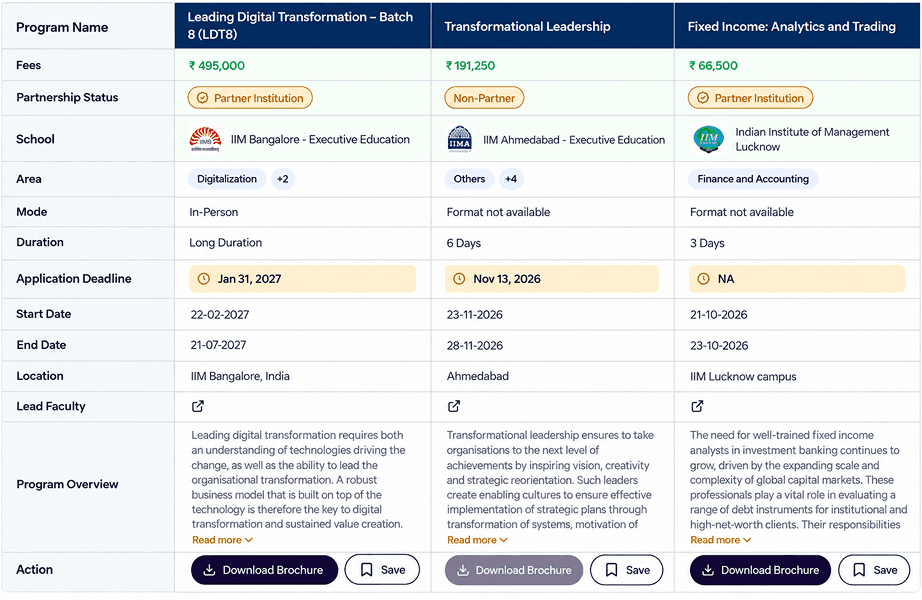
Finding the right options can itself take time, particularly when professionals are comparing programmes across different institutions, formats and specialisations. Echomind Explorer helps simplify this discovery and comparison stage by bringing executive, leadership and management programmes into one place. Professionals can explore programme details such as faculty, projects, duration, learning format, modules and technology components before deciding which options are worth considering. An executive programme whose learning can be applied to an existing workplace challenge gives you a clearer business case to present to your employer. Instead of asking the company to fund a course simply because it is valuable for your career, you can demonstrate how the learning connects to current responsibilities and organisational priorities.
Connect the Programme to a Business Problem
One of the strongest ways to make a sponsorship request is to connect the programme to a problem the organisation is already trying to solve. This approach positions executive education as a part of a broader capability-building conversation and a crucial business investment. Suppose your company is expanding into new markets. In that case an executive programme covering strategy, finance, and leadership suggested by you shows that you want involvement in cross-functional planning. You frame your professional development as a targeted solution to organizational pain points. This orientation shows that you are thinking beyond your career progression.
What Steps to Include When Asking For a Sponsorship
Before approaching your company to sponsor your executive education, you need to draft a solid proposal. A proposal should outline the specific skill gaps, demonstrate how your efficiencies will benefit the team, provide a transparent cost breakdown, and address workload management. This business case should look like a mutually beneficial investment.
Check Your Company’s Policy
It is important that you do a thorough investigation of your organisation's internal policies about how they support learning goals of the employees. Understand existing frameworks of learning and development (L&D) budgets, reimbursement schemes, professional development allowances. Being aware about these things will help you structure your proposal in line with the guidelines of your company. Check if your company has some predefined criteria. Knowing tenure requirements, grade level eligibility, and other criteria will help you acknowledge the competition.
Ask Your Manager and Peers
Your manager is often the best starting point. The final approval may come from HR or the L&D team, but your manager can help with the process. Make sure your tone is not confrontational and does not sound like an ultimatum. Keep the conversation straightforward, and try to open a professional discussion about mutual value. If anyone among your peers has opted for a programme sponsored by the company, their insight will be quite helpful.
Prepare for the Cost Question
Cost will naturally be part of the conversation, and that is where knowing the company policy will come in handy. Professionals can use Echomind Explorer to compare executive programmes across factors like fees, duration, mode and specialisation before presenting. After investigating the company policy thoroughly, you can structure your request accordingly. This varies from company to company. So your company might cover the full programme fee, contribute a percentage, reimburse after completion, or fund it through an existing L&D initiative.
Show That You Have Thought About Your Workload
An executive programme requires time outside your normal working responsibilities, which will bring up concerns about your work commitments. Before these concerns become objections from your manager’s end, demonstrate how you will manage the extra responsibilities. Explain the programme schedule, class timings, and learning modes, and how you will work around them. This signals to your company that a sponsorship does not mean transferring your workload to your team.
Build a Business Case
After identifying the right programme for yourself, prepare a simple business case from your company’s perspective. They might want to know:
Question | What to Include in Your Answer |
Why are you choosing this specific programme? | Explain the capability gap you want to address and how the programme will help you meet your current or future responsibilities. |
Why do you wish to pursue it now? | Identify a current business requirement, changing workflow, or upcoming responsibility that makes the learning particularly relevant at this stage. |
What will the company gain? | Highlight potential benefits such as improved processes, better decision-making, stronger project execution, or greater cross-functional effectiveness. |
How will you manage the workload? | Explain how you will balance classes, assignments, and study time with your existing responsibilities without affecting work commitments. |
What is the investment? | Provide a transparent breakdown of programme fees and any additional costs. Mention whether you are open to contributing a portion of the expense, if applicable. |
Email Template to Request Company Sponsorship for an Executive Programme
Once you have identified the right programme with the help of our website and prepared your business case, the next step is to approach your manager or HR team. Your email should clearly explain why you want to pursue the programme, how it relates to your role, and what the organisation stands to gain. Use the following template to structure your request:
Subject: Request for Sponsorship for [Executive Programme Name] Dear [Manager's Name], I am writing to explore the possibility of company sponsorship for [Executive Programme Name] offered by [Institution Name]. As part of my current role as [Your Designation], I have been working on [relevant responsibility, project, or business challenge]. I believe developing my skills in [specific capability or subject area] would help me contribute more effectively to these responsibilities and support our team's objectives. The programme covers [relevant modules or skills] and offers practical learning that I could apply to [specific business need, project, or process]. I see this as an opportunity to strengthen my capabilities while bringing relevant insights and practical improvements back to the team. The programme runs for [duration] in a [learning format] format, with a total fee of [amount]. I have considered the schedule and can manage the coursework alongside my existing responsibilities. I would appreciate the opportunity to discuss whether the company could support this programme through full or partial sponsorship, reimbursement, or an applicable learning and development initiative. Please let me know a convenient time to discuss this further. I would be happy to share the programme details and explain how the learning aligns with our team's priorities. Thank you for your time and consideration. Best regards, [Your Name] [Your Designation] |
What If Your Company Says No?
A rejection does not necessarily mean that the programme lacks value. The organisation may have budget constraints, a different L&D priority or policies that do not cover external executive programmes. Ask whether partial funding, reimbursement, flexible working arrangements or another form of support could be considered. Do not forget to ask what would make the proposal more suitable for future consideration. This will provide useful information about how your organisation approaches professional development.
Turn Professional Development Into a Shared Investment
For working professionals, executive education should drive practical business outcomes rather than just earn a degree. Consequently, requesting company sponsorship requires more than sharing a course brochure.
You must explain the value of the learning, demonstrate how it enhances your role, and show how the organisation benefits. Frame the request as a shared proposition: the company invests in your capabilities, and you apply them to generate workplace value.
Finding the right program is essential. Echomind Explorer helps professionals narrow down relevant executive education options. It is based on target capabilities, enabling a focused evaluation aligned with role and organizational needs before presenting a clear rationale to employers. Echomind simplifies the initial research process by bringing relevant programme information together. Connecting professional development directly to business outcomes turns executive education into a strategic, future-ready investment for both you and your organisation.
Share :