
Short Duration vs Long Duration Executive Programmes: A Practical Comparison for Busy Professionals

Share :

Executive education has now become an important part of climbing the professional ladder. It is difficult for a working professional to follow a traditional learning and academic schedule. Due to work and personal commitments, they cannot take time off and dedicate a year or two to a degree. That is why executive programmes have garnered attention amongst working professionals. It allows professionals to build new capabilities without hampering their careers.
You’ve hit a plateau in your learning or your salary. Now you have decided to change this by pursuing an Executive Programme. But how do you choose an executive programme suited for you? It's beyond finding the right institution or stacking new skills. Duration is also a big factor for busy professionals when choosing an executive programme.
Typically, there are short and long-duration programmes, each with its own advantages and disadvantages. Short duration executive programmes can help professionals address a specific skill gap within a limited timeframe. Long duration programmes offer a more structured learning journey, often covering multiple areas over several months. So which format is best suited for you? Which format should a busy professional choose? Well, the answer depends on factors like your career stage, learning objective, available time, and how deeply you need to engage with the subject.
What Are Short Duration Executive Programmes?
Short-duration executive programmes are designed to help professionals develop knowledge and skills within a compressed timeframe. These focused learning interventions cover areas like strategy, leadership, analytics, technology, innovation, and operations. Depending on the university and the programme, these short-duration programmes usually last around 2 to 15 days. These programmes require minimal time away from work and are particularly useful when learning requirements are specific.
Short-duration programmes usually happen on campus, giving professionals a great chance to network and connect with their peers. These programmes suit senior leaders who need immediate, targeted tactical insights. So instead of committing to a lengthy programme, they can choose an executive course around the capability they need.
Who Should Opt for a Short Duration Programme?
A short-duration programme is best suited for professionals who:
have a clearly defined skill gap.
need to learn something in a short time.
cannot commit to a long-term course due to their professional schedule.
want exposure to a new business function.
are evaluating whether a particular subject is relevant to their career.
need to refresh an existing capability.
want to complement their current expertise with a specialised skill.
The biggest advantage of short-duration programmes is focus. Instead of spending several months covering a broad curriculum, professionals can concentrate on one subject. Short-duration programmes can be equally demanding because of limited time frames. Several classes are held on a single day to cover an advanced subject in a time crunch. Short-duration courses are perfect for professionals wishing to fulfill a specific skill gap with immediate application.
What Are Long Duration Executive Programmes?
Unlike short-duration programmes, long-duration programmes don’t have a time constraint. Long-duration executive programmes offer professionals an extended learning journey. Generally, these programmes combine multiple modules and allow professionals to engage with a subject over several months. Long-duration programmes usually cover comprehensive domains like general management, leadership, digital transformation, business analytics, and sector-specific areas. Ranging from 2-12 months, long-duration programmes offer a blended learning format, with online learning and campus immersions.
These courses are for professionals who want an in-depth understanding. The additional time creates room for more than content delivery. Professionals can revisit concepts, participate in discussions, work through assignments, interact with peers, and consider how the learning applies to their organisations. Long-duration programmes are more relevant when the goal is broader capability development rather than a single skill. If you can adjust the extra responsibilities around your work schedule, then a long-duration programme is perfect for you.
Who Should Opt for a Long Duration Programme?
A long-duration executive programme is worth considering for professionals who:
want to develop broader management capabilities.
are preparing for a larger leadership role.
are moving into a new function or business area.
need structured learning over several months.
want deeper engagement with a subject.
want time to apply concepts between learning sessions.
are looking for a more comprehensive executive education experience.
Just because long-duration programmes have an online mode does not make them easy. They can be equally demanding, especially with a job and other responsibilities. Though demanding, long-duration programmes support reflection and application of learning. Participants in long-duration programmes are usually given alumni status, depending on the university. These programmes are best suited for mid-career professionals seeking structural career advancement or transition.
Short Duration vs Long Duration: A Practical Comparison
When we compare the two formats across the factors that actually matter to different working professionals, the difference becomes clear. Neither of the formats is universally suited for professionals. The better choice is the one that is attuned to the requirements of the professional.
Factor | Short Duration Executive Programme | Long Duration Executive Programme |
Typical commitment | Typically 2-15 days long | Typically 2-12 months long |
Learning objective | Hyper-specific skills, and focused subject | Broader capability, comprehensive domains, and deeper expertise |
Time commitment | Lower overall commitment | Higher sustained commitment |
Curriculum | Usually concentrated around a defined topic | Usually broader and more structured |
Application | Immediate application of specific concepts | Application across multiple modules and projects |
Peer interaction | Concentrated during the programme | Develops over a longer period |
Alumni Status | Granting of alumni network status depends on the university | Frequently grants official executive alumni network status |
Career stage | Useful across career stages for targeted upskilling | Often useful for professionals seeking broader development |
Format | Usually in-person on campus | Hybrid blend of live online lectures and brief campus immersions |
Best suited for | Specific capability gaps | Strategic, leadership, or comprehensive development |
How to Apply These Parameters to Your Own Decision
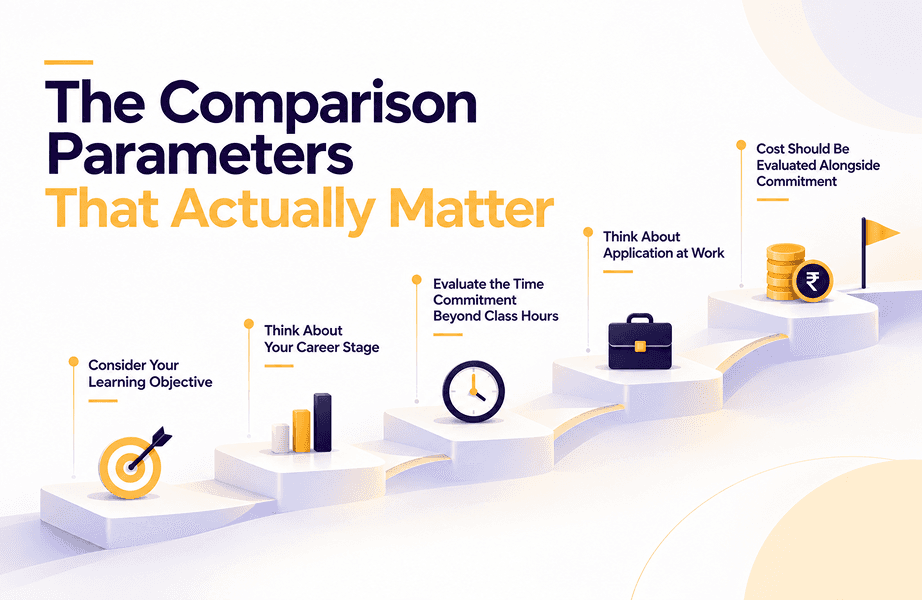
1. Consider Your Learning Objective
Duration should not be the first question you ask. Start with the problem you want to solve. Identifying a specific skill gap will help you realise which format is better for you. For a product manager wanting to understand data analytics to make better product decisions, a focused programme can help. But a professional preparing for a transition into a general management role will need a broader programme structure. This distinction is important.
2. Think About Your Career Stage
Your current career stage can also influence the decision. An early or mid-career professional may need targeted skills and a short duration programme can address it without requiring a major time commitment. A senior professional needs a long duration executive programme that can prepare for a broader role. This does not mean short programmes are only for junior professionals or long programmes are only for senior executives. The important factor is alignment between the programme and your professional objective.
3. Evaluate the Time Commitment Beyond Class Hours
Class hours alone don't reflect the full time commitment of executive programmes. Short programmes demand intensive, full-time focus with packed sessions and evening prep, requiring complete leave from work. Long programmes span months, requiring steady weekly hours for lectures, readings, assignments, and projects alongside your job. Choose the format that fits your schedule: short, immersive sprints or a sustained, multi-month workload.
4. Think About Application at Work
The value of an executive programme depends on how well learning transfers to your daily role. Short programmes address specific skill gaps and enable immediate application on active projects. Long programmes span several months, allowing time to test management strategies, gather feedback, refine approaches, and complete capstone projects. While short courses address immediate tactical needs, long-duration formats foster sustained reflection across complex challenges.
5. Cost Should Be Evaluated Alongside Commitment
Programme fees are another important consideration, but they should not be viewed in isolation. Compare the cost against the learning objectives, duration, delivery format, faculty, curriculum, and professional relevance. A shorter programme may involve a smaller financial and time commitment. A longer programme may require a larger investment but provide broader learning and extended peer interaction. Professionals should also consider whether their organisation offers learning and development support or executive education sponsorship.
How Echomind Can Help You Compare Executive Programmes
With demand for executive education, many universities, edtech platforms, business schools, and corporate learning providers offer several programmes. Programmes range across leadership, management, technology, analytics, finance, strategy, and other areas. Finding an executive programme isn’t complex. The challenge lies in identifying a programme that fits your professional requirements. Here, a structured approach to executive education research can help.
Echomind does exactly that. It is a one-point dashboard that saves you from hours of mindless searching. Echomind Explorer helps professionals shortlist high-impact programmes in executive presence, cross-functional leadership, and management. It suggests programmes based on their professional profile and learning requirements. Instead of browsing programmes randomly, professionals can use their current experience and career goals as starting points. This can be particularly useful when deciding between short and long-duration options. Once you identify a specific capability gap, you can explore programmes addressing that requirement. The objective is to find a programme that addresses a specific professional need.
Conclusion
Choosing between a short-duration and a long-duration executive programme ultimately comes down to your personal career objectives, available bandwidth, and learning goals. Short duration programmes offer quick, high-impact upskilling for immediate skill gaps. While long duration programmes provide comprehensive, foundational growth for major career transitions or leadership roles. By assessing where you are in your professional journey and where you want to go, you can select the format that delivers the greatest value and sets you up for long-term success.
Share :