
How to Evaluate an Executive Programme Before Recommending It to Your Team

Share :

You are an HR leader, L&D professional, business head or a manager who wants to recommend an executive programme to your team. Don't forget that choosing and selecting a programme for yourself is different from recommending one to your team. Your responsibility doesn't end after checking the cost breakdown and the institution’s reputation. These factors don’t even scratch the surface of what you should evaluate in an executive programme before recommending it to your team.
As a leader or manager, it is important to consider that the programme addresses a genuine capability gap. Check that the executive programme fits the needs of your team and creates meaningful value for the organisation. A programme may look impressive on paper but still be unsuitable for your organisation. With the growing range of executive education options, it is difficult to find and choose the perfect fit for your team. This is where platforms like Echomind help. Echomind Explorer has 2000+ executive programmes from IIMs, IITs, ISB and leading global institutions in one place, making it easy to compare.
How Can an Executive Programme Help Your Team?
In today's world, these high-performing teams are indispensable to companies. But how do you make your team a high-performing one? A simple answer would be that often executive programmes help in building high-performing teams. Executive education exposes team members to contemporary strategic frameworks and industry best practices. This fosters a culture of continuous learning and innovation. These programmes help build leadership skills, improve daily collaboration, and align individual efforts with business goals. They empower future leaders by sharpening critical thinking, decision-making, and cross-functional communication.
Evaluate the Right Executive Programme for Your Team
Before recommending an executive programme to your team, evaluate it across several dimensions by asking the right questions.
What needs to improve?
Who needs this learning?
How does the curriculum address the gap?
How can employees apply the learning?
What will the organisation spend?
What should change after the programme?
How will the outcomes be evaluated?
Executive Programme Evaluation Scorecard
Use this scorecard to assess each shortlisted programme against your team's learning needs and organisational priorities.
Evaluation criterion | What to check |
Capability gap | Does the programme address a clearly identified skill or business need? |
Curriculum relevance | Are the modules aligned with employees' roles and development goals? |
Content currency | Does it cover current industry practices and emerging business needs? |
Faculty expertise | Do faculty members bring relevant academic and industry experience? |
Programme format | Does the schedule fit employees' workloads and availability? |
Participant profile | Is the cohort suitable for your employees' experience and seniority? |
Practical application | Can employees apply the learning to real workplace challenges? |
Institutional recognition | Does the institution and programme have relevant credibility? |
Total investment | Are the fees and additional costs justified by the intended outcomes? |
Success metrics | Can the organisation evaluate whether the programme delivers the expected results? |
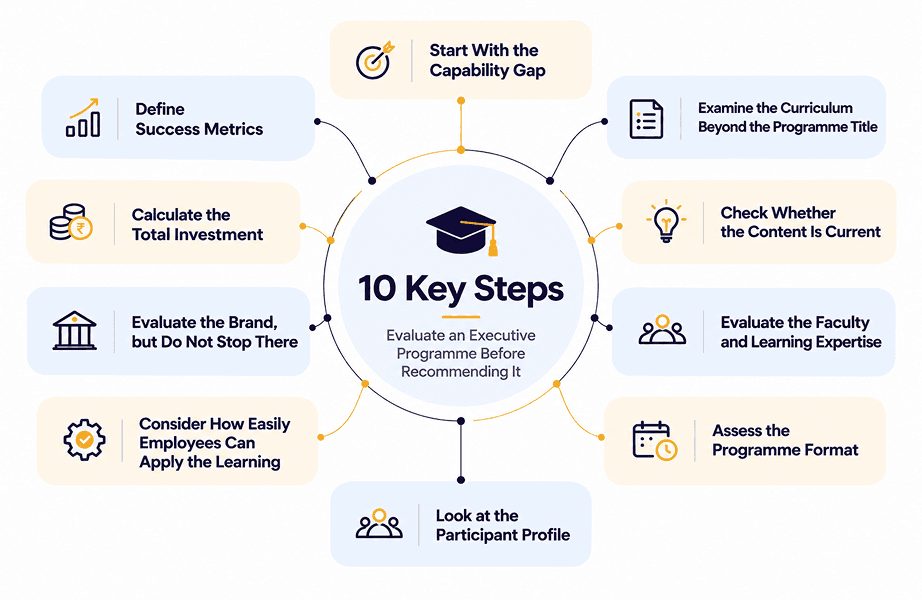
1. Start With the Capability Gap
Before jumping straight to “Which executive programme should we choose?” Start by seeking the answer to what capability we’re trying to build. This slight change will drastically improve the way leaders and managers approach executive education. An organisation may say it wants to invest in leadership development, but the actual capability gap could involve several things. It could be managing cross-functional teams, strategic communication, decision-making, stakeholder management or leading digital transformation. These requirements call for different learning interventions. So before you evaluate an executive programme, you must define,
The target employee group
Their current skill level
The capability gap
The business problem behind the gap
The expected workplace outcome
How success will be measured
2. Examine the Curriculum Beyond the Programme Title
Don’t get flattered by attractive programme titles. Read beyond the name. Go through the curriculum carefully. Look at the modules, learning outcomes, assignments, and practical components. Check if the modules are cohesive. See whether the content is relevant to the employees attending. You cannot expect a senior professional to sit through a course focused on teaching basic business skills. A strong executive programme gives clarity on what participants will learn. It demonstrates how the learning builds over time and how it relates to their professional responsibilities.
3. Check Whether the Content Is Current
A good executive programme reflects how businesses operate today, especially the areas that are changing rapidly. AI, automation, analytics, cybersecurity, digital transformation and emerging technologies can evolve considerably within a short period. Therefore, a programme that was relevant several years ago may not address today's workplace requirements. Current, however, does not mean only trending terminology. It means a programme that explores practical applications and current business challenges. As a leader/manager, your objective should be to identify programmes that develop capabilities rather than simply following trends.
4. Evaluate the Faculty and Learning Expertise
Good faculty significantly influences the quality of an executive programme. It would be unjust to assess faculty only by their academic qualifications; one must also consider their industry experience and teaching expertise. Depending on the programme, your team may benefit from:
Academic faculty with strong subject expertise
Industry practitioners with current business experience
Senior executives who can provide practical perspectives
Case-based teaching
Applied projects
Guest sessions from industry leaders
A programme focused on business strategy may benefit from faculty with strong academic and consulting backgrounds. An applied technology programme may require practitioners who understand how organisations are implementing the technology. The right mix depends on the learning objective.
5. Assess the Programme Format
As a leader, you want the learning format of the programme not to become a hindrance to your work. That is why many working professionals prefer online executive programmes, as they provide greater flexibility. They can learn without sacrificing their professional growth and commitments. But your work isn't over just because it says online. Check the schedule and see if it’s actually flexible enough to fit around your team’s work commitments. Your evaluation should therefore consider the actual time commitment.
6. Look at the Participant Profile
Before recommending, take a look at who typically joins the programme. Are they mid-career professionals, senior managers, entrepreneurs, functional specialists or early-career employees? The answer matters because peer learning is one of the understated benefits of enrolling in an executive programme. Participants can learn from people facing comparable business challenges. A diverse cohort exposes employees to different approaches to problem-solving. When evaluating a programme, therefore, consider not only what the institution teaches but also who your employees will learn alongside.
7. Consider How Easily Employees Can Apply the Learning
One of the most important questions is what happens after the programme. Can the team implement what they have learned? Executive education should ideally connect classroom learning with workplace application. The closer the learning is to an employee's actual responsibilities, the greater the opportunity to transfer knowledge into the workplace.
It is important for leaders to look for programmes that incorporate business cases, practical assignments, action-learning exercises, and industry examples.
8. Evaluate the Brand, but Do Not Stop There
Institutional reputation matters, particularly for executive education, as it provides credibility and access to an established alumni network. However, brand recognition should be one consideration rather than the entire evaluation. A well-known institution can still offer a programme that does not match your team's capability requirements. The right question is not simply whether the institution is prestigious. It is whether the specific executive programme is suitable for the employees and business objectives you have identified. Tools like Echomind Explorer help shift the focus from simply finding a prestigious programme to finding one that fits the your team’s capability needs.
9. Calculate the Total Investment
Programme fees are only one part of the investment. Before recommending, one must consider its broader cost to the organisation. That could include travel, accommodation, managerial support, administrative costs, work disruption, etc. The objective is not to force every learning intervention into a precise financial return calculation. Some outcomes, particularly leadership development, can take time to become visible. Instead, establish clear expectations about what the investment is intended to achieve. HR and L&D leaders can use Echomind Explorer’s Budget Planner to organise learning budgets, allocate funds across teams, and plan programme investments based on organisational priorities.
10. Define Success Metrics
Before recommending an executive programme, define what success looks like. Completion rates alone will not tell you whether the programme created organisational value. Depending on the objective, you could measure:
Application of new skills
Changes in employee capability
Improvement in project outcomes
Internal mobility
Leadership readiness
Productivity improvements
Quality of decision-making
Adoption of new tools or processes
Manager feedback
Employee feedback
Solve Capability Needs with Executive Education
Recommending an executive programme is ultimately an L&D decision, not simply a course-selection exercise. The strongest approach begins with the organisation's capability needs and works backwards. For HR and L&D teams, the goal should be straightforward: put the right learning opportunity in front of the right employees at the right stage of their professional development.
Managers need to see what employees need to do better. Identify the skills required to support that goal. Then evaluate programmes based on curriculum, faculty, format, peer group, practical application, investment and measurable outcomes. This is where tools like Echomind step in. Echomind Explorer acts as a single point of discovery for managers and leaders exploring executive education in India. Echomind gives a structured way to discover, compare and shortlist executive education programmes. This helps organisations avoid selecting programmes that sound impressive and instead focus on solving a business need. When executive education is evaluated through that lens, it becomes more than an employee benefit. It becomes a structured way to build the capabilities your organisation will need next.
Share :