
How Mid-Career Professionals in India Are Using Executive Education to Break the Salary Plateau

Share :

During the first few years of your career, you experience predictable growth with promotions, job switches, and new responsibilities. After a decade or more, you are a mid-career professional who is at a certain salary level. It feels like you have hit an invisible ceiling, and your growth starts to slow down. This is the salary plateau. At this stage in your career, you will be managing a bigger team. But that doesn't mean a proportionate increase in your salary.
You might think If I work hard enough, I’ll be able to tackle this, but that worked during your early years. Now you are highly efficient in your existing role, but organisations have also grown. They are more technology-driven, with AI reshaping workflows; having years of experience in your niche isn’t enough. The roles and salary range you want require more than experience; they require cross-functional fluency.
This is where executive education sweeps in. Executive education from India's leading business and management schools like IIMs and IITs is gaining attention among experienced professionals in India. Instead of full-time degrees, experienced professionals are now opting for specialised courses, programmes and certifications to move ahead. Executive education gives professionals visibility, connections, skills, and adds weight to their portfolio.
What Is a Salary Plateau for Mid-Career Professionals?
Mid-career professionals are usually aged 35 to 45 years and have years of experience in their field. A salary plateau happens when compensation becomes stagnant despite the increasing experience and responsibilities. A professional can quickly move from an entry-level salary to ₹10 lakh within the first few years. However, once they reach the ₹15 to 20 lakh range, the subsequent increases may become smaller. It doesn't change unless they develop specialised capabilities, move into management, or change career direction. Several factors can contribute to this plateau:
Experience without expanding responsibilities
You have spent several years doing the same type of work, which has built your experience. But that isn't enough to move to senior positions.
Limited technical or digital skills
The industry expects professionals to be fluent with changing technologies and to understand data, AI, and other automation tools.
Narrow specialisation
Senior-level management and hiring managers will look for cross-functional leadership roles. Your expertise in one operational area may not be enough.
Weak strategic exposure
Senior positions often require business thinking rather than task execution alone.
Fewer promotion opportunities
Organisational hierarchies have limited senior positions, making internal progression more competitive.
Changing employer expectations
The job description for mid-career professionals includes skills that they may have needed when they started their careers.
Recognising these factors can help professionals understand why simply waiting for another increment may not solve the problem.
Why Experience Alone May Not Increase Your Salary
Experience is a valuable asset for professional growth, but its impact changes as a career progresses. During early career days, experience shows that a professional can perform a particular job, giving them leverage. But at the senior level, employers' expectations are different. They look for individuals who can solve broader business problems, lead across teams, and make decisions using technology and data.
Consider two professionals with 12 years of experience. One has spent most of that time performing similar responsibilities and building only their niche. The other has progressively added skills in business analytics, AI tools, stakeholder management, and strategic planning. While their years of experience may be similar, their potential contribution to an organisation can vary. Career growth isn't about accumulating years. Rather, it is about increasing the value attached to those years. Executive education can help professionals bridge this gap by adding structured learning to their existing professional experience.
Why Executive Education Appeals to Working Professionals
As a mid-career professional, it's impractical to leave your job and pursue a traditional postgraduate degree. It will not be a good professional or financial decision because of responsibilities at this age. Executive education offers a different model. These programmes are designed by India's top B-schools, keeping working professionals in mind. Executive courses offered by IITs, IIMs, ISB etc., build your portfolio and give you alumni status of such prestigious institutions.
Unlike traditional degrees, these programmes allow people to learn alongside their work. For better suitability, professionals may choose courses with weekend classes, online sessions, short-term modules, projects, case studies, or blended frameworks for a nuanced learning experience. This makes executive education relevant for mid-career professionals. It helps enhance and build on their skills without pausing their work. For mid-career professionals, executive education enables them to learn new skills, cross-functional fluency, and elevation. These courses expand their market value and open doors to higher-level management opportunities.
How Executive Education Drives Growth
Executive education professionals are not trying to reinvent their careers or change their trajectory. Rather, they are trying to combine their already existing expertise with new expertise. Executive education has gained attention among Indian professionals because of its convenience and prestige.
Executive education courses offer a great networking opportunity for professionals, as they get to meet people from diverse walks of life. Learn new perspectives and business strategies.
With executive education, mid-career professionals stay relevant by learning about upcoming technologies and automation in the industry.
Executive education builds skills, boosts confidence, equips participants with cross-functional fluency, and helps in building a strong personal brand.
Executive education from top B-schools helps mid-career professionals add weight and upgrade their resume.
Enhancement in business vision is one of the greatest assets provided to those enrolled in an executive education course.
Executive education equips professionals with skills required to lead and manage at a high level. They gain enhanced business vision and build greater analytical skills.
Executive education courses are designed with professionals in mind. They don't require professionals to take a break from their careers to pursue learning.
These structured learning modules help you take a step back and engage with new perspectives.
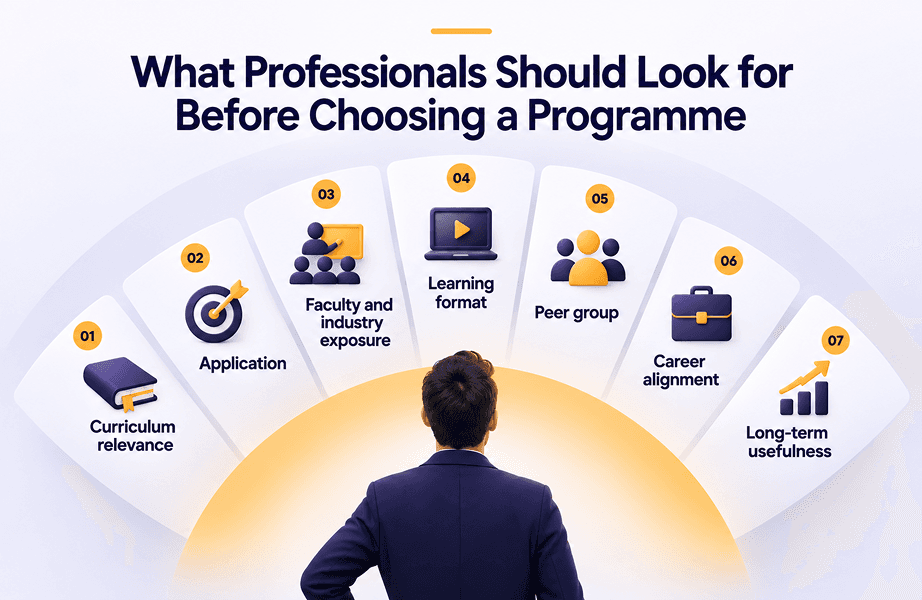
What Professionals Should Look for Before Choosing a Programme
Executive education requires an investment of time, money and attention. Choosing a programme simply because it carries a prestigious name will not address the actual career problem. Professionals should evaluate programmes based on practical factors such as:
1. Curriculum relevance - Does the programme teach skills that are becoming important in the target role?
2. Application - Does the programme involve projects, case studies or practical assignments?
3. Faculty and industry exposure - Are learners exposed to people with relevant academic or industry experience?
4. Learning format - Can the schedule realistically fit alongside a demanding job?
5. Peer group - Will the cohort include professionals who can provide meaningful perspectives and collaboration?
6. Career alignment - Does the programme support the professional's intended career direction?
7. Long-term usefulness - Will the skills remain relevant beyond the immediate job transition?
Echomind Explorer is the perfect one-point dashboard for professionals who are looking for such executive education courses. The objective is not to simply collect another certificate. It is to build capabilities that remain useful as the professional's role evolves. A certificate can demonstrate that someone studied a subject. A successful project can demonstrate that they know how to use it.
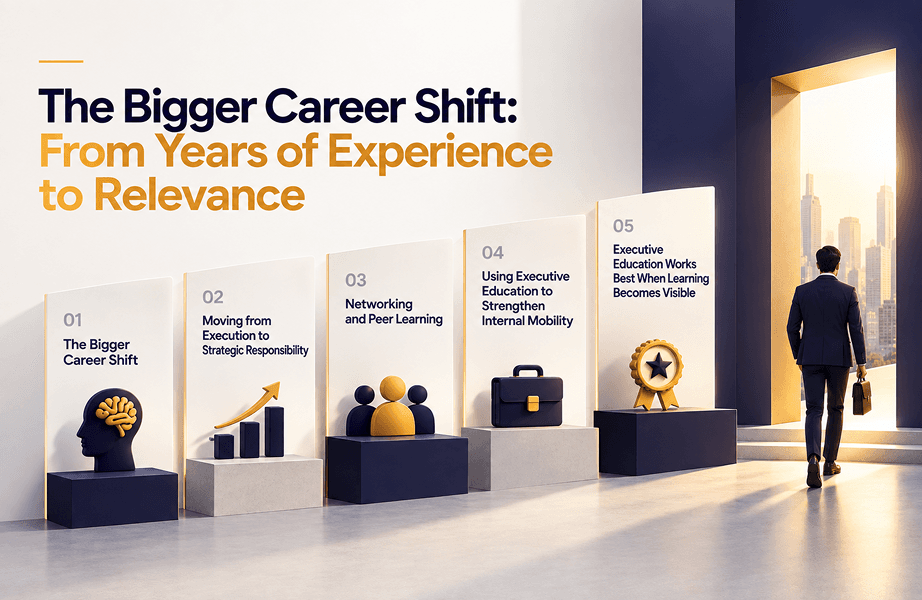
The Bigger Career Shift: From Years of Experience to Relevance
The mid-career phase is increasingly about staying relevant. A professional with 15 years of experience cannot compete with changing workplace expectations simply by pointing to those 15 years. They need to show how their experience applies to today's business environment. That could involve learning AI, strengthening leadership skills, developing strategic thinking and acquiring knowledge of an adjacent function. Executive education is one route professionals are using to make that transition while remaining employed.
Moving from Execution to Strategic Responsibility
Professionals attempt to move beyond a salary plateau by changing the type of work they perform. By moving towards strategic responsibilities, professionals can create access to different career paths. Executive education supports this transition. It exposes professionals to business cases, strategic frameworks and problems beyond their immediate functional responsibilities.
Networking and Peer Learning
Mid-career professionals often learn from peers who work in different companies, sectors and functions. It is useful for professionals who have spent many years within one specialised function. This peer group learning provides exposure to roles and industries they may not have previously considered.
Using Executive Education to Strengthen Internal Mobility
Changing companies is not the only way to increase compensation. Some professionals use executive education to become candidates for opportunities within their existing organisations. The key is to connect learning with an identifiable business opportunity.
Executive Education Works Best When Learning Becomes Visible
After completing their programme, professionals should try to overcome their salary plateau by applying their learning immediately. Like volunteering for a transformation project, automating a repetitive process, or analysing business data. This becomes an evidence of capability.
How Echomind Fits Into the Mid-Career Learning Journey
A salary plateau does not necessarily mean that a professional's career has reached its limit. Instead, it is a signal that the relationship between experience, skills and market value needs to change. To stay relevant and move forward, they need to gain additional capabilities along with their years of experience.
That is exactly what Echomind Explorer is built to do. It is a one-stop solution that saves you hours of research.
It offers executive, leadership and management courses from top business schools in India like IITs and IIMs. The Echomind Explorer shortlists high-impact programmes targeting executive presence, strategic persuasion, corporate governance, and cross-functional leadership. It matches your current profile to the precise course that bridges your specific gap. Your next career breakthrough starts with knowing what to learn next.
Share :