
Columbia Business School

Driving Strategic Impact: Mastering Management Consulting Skills

Columbia Business School

Strategy & Innovation

About Programme

Organizations across industries are operating in environments defined by rapid change, compressed decision cycles, and increasing uncertainty. Leaders are required to make more consequential strategic decisions with less time, more data, and fewer clear answers than ever before. Yet many organizations struggle to deliver sustained strategic impact because the gap between insight and execution remains difficult to close—especially within real constraints such as culture, incentives, legacy systems, talent, and competing priorities.

Driving Strategic Impact: Mastering Management Consulting Skills is a three-day, in-person program designed to address this challenge by equipping leaders with a strategy-focused toolkit to make better decisions and drive execution in dynamic, uncertain environments. Participants learn how to assess strategic options, derive insight from data and experience, and mobilize organizations to act—particularly when the pace of change is high, and the path forward is unclear.

The program emphasizes the development of strategic judgment, the ability to synthesize insights into clear recommendations, and the leadership confidence required to influence decisions and drive coordinated action across stakeholders. Participants leave with a practical, repeatable approach to translating analysis into direction—and direction into action that delivers measurable impact.

Strategic decisions are rarely made with complete information. Leaders must learn how to exercise judgment, weigh tradeoffs, and move forward despite uncertainty.

Angela Lee

Faculty director Angela Lee introduces the program.

Programme Content

Driving Strategic Impact is built around a structured, repeatable approach that helps leaders move from ambiguity to insight—and from insight to decisions and execution.

Participants work through six interconnected stages that mirror the lifecycle of high-stakes strategic decisions:

Define the Problem: An effective strategy begins with framing the right problem. Participants learn how to clarify objectives, identify the true decision at hand, and define what success looks like before moving to solutions. This stage emphasizes the importance of understanding context, decision ownership, and constraints early—because the quality of a strategy is shaped by how well the problem is defined.

Structure the Problem: Complex strategic challenges must be broken into manageable components. In this stage, participants practice structuring issues, forming hypotheses, and prioritizing areas of focus. The goal is to avoid analysis paralysis and ensure effort is directed toward the questions that matter most for decision-making.

Conduct Analysis: Participants learn how to design and execute analysis effectively in complex environments. This stage focuses on upfront planning analysis, reducing redundancy, and concentrating effort on high-value questions. It also addresses how cognitive biases influence interpretation and how leaders can surface meaningful insights from large, imperfect, or overwhelming datasets.

Synthesize Recommendations: This stage emphasizes judgment and synthesis—moving from analysis to clear, actionable recommendations. Participants learn to weigh trade-offs, assess risk, and articulate a coherent point of view rather than present disconnected findings. The focus is on developing recommendations that are decision-ready and grounded in both evidence and experience.

Communicate for Insight: Strong ideas only matter if they shape decisions. Participants develop techniques for communicating insight clearly and persuasively, tailoring messages to different stakeholders, and building alignment around recommendations. This stage strengthens strategic storytelling and executive communication to influence decisions and mobilize action.

Execute Through Constraints: The final stage focuses on turning aligned decisions into action. Participants examine how leaders manage strategic initiatives when outcomes are uncertain, timelines are compressed, and coordination across people and functions is required. Topics include adapting plans as new information emerges, aligning incentives, managing risk, and sustaining momentum over time.
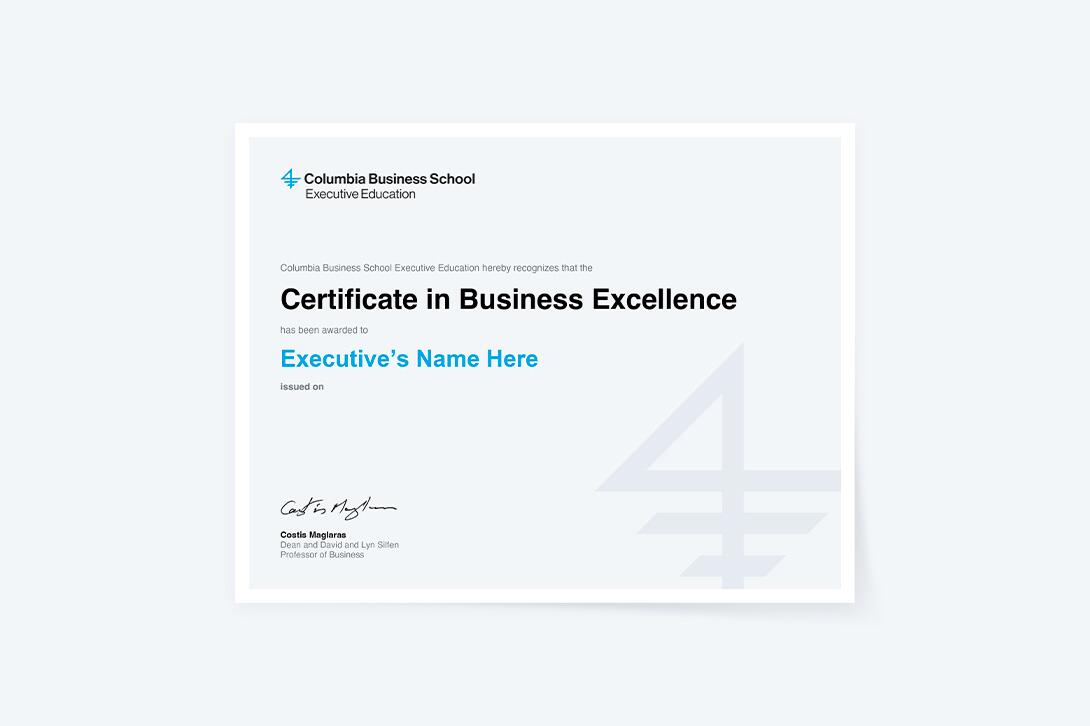
Programme Audience

Driving Strategic Impact is designed primarily for mid-level executives from a wide range of industries who are looking to strengthen their strategic thinking and structured problem-solving capabilities in order to make greater contributions within their organizations.

The program is particularly valuable for high-potential leaders who are being prepared for expanded responsibility and greater decision-making authority. Participants are often tasked with leading strategic initiatives, supporting senior decision-makers, or translating analysis into recommendations and action across teams and functions.

Participants typically come from roles such as:

Directors and senior managers
Emerging leaders in strategy, growth, or transformation roles
Product, innovation, and business unit leaders
High-potential functional leaders in finance, operations, analytics, or related areas

Other programs in this subject area you might find useful

Same topic, Similar duration - Broader exploration across all institutes

Contact us for the further details

Speak with an Advisor

  1. Pedagogy (case method, experiential learning, coaching, simulations)
  2. Programme Objective
  3. Testimonials
  4. Programme Benefits

Prashansa Uttam

Programme Advisor

+91 9403890085[email protected]Mon – Fri, 9am – 5pm IST

Columbia Business School

Executive Education Office

John Cissel
+1 212-853-4249
https://academics.gsb.columbia.edu
New York, USA

Tell us about your program enquiry

Fill out the form below and our team will get back to you within 24 hours.

Driving Strategic Impact: Mastering Management Consulting Skills | Columbia CBS