Indian Institute of Technology Delhi

Artificial Intelligence And Machine Learning For Industry

Indian Institute of Technology Delhi

eVIDYA

Application Deadline Approaching

Last date to apply: January 8, 2027 · Program starts on January 9, 2027

About Programme

Imagine standing at the crossroads of innovation, where Artificial Intelligence (AI) and Machine Learning (ML) are reshaping industries at an unprecedented pace. Whether it's predicting customer behavior in marketing, diagnosing diseases with precision in healthcare, or optimizing game strategies in sports, AI/ML is the driving force behind transformative change. Now, picture yourself not just witnessing this revolution—but leading it.

CEP IIT Delhi's AI & ML for Industry programme is your gateway to mastering these powerful technologies.

Designed for both tech enthusiasts and professionals from non-computer science backgrounds, this course demystifies complex algorithms and turns them into practical, real-world solutions. Through a perfect blend of theory and hands-on experience, you'll gain the skills to apply AI/ML techniques in sectors ranging from e-commerce and engineering to power and policy-making. But learning AI/ML isn't just about theory—it's about application. That's why this programme immerses you in real industry case studies, From predictive analytics to intelligent automation, you'll experience first-hand how these technologies are shaping the world.

Programme Content

1. Self-Paced Module — Practical Python for Industry Professionals

Foundations of Python Programming

2. Mathematical Foundations for AI/ML

Motivations and Introduction to Different ML Paradigms

Linear Algebra for ML

Vectors and Matrices

Vector Space and Subspace

System of Linear Equations

The Concept of Rank and Independent Vectors

Inner Product Space

Norms

Positive Definite Matrix

Matrix Factorisation (EVD, SVD, QR, LR, etc.)

Projection and Orthogonality

Probability and Statistics for Data Science

Random Variables

Distribution and Density Functions

Conditional Probability

Bayes' Theorem

Joint Distribution

Concept of Independence Covariance and Correlation

Introductory Statistical Inference (Likelihood, MAP, etc.)

Concept of Entropy

Mutual Information and KL Divergence

Optimisation

Function and Derivatives

Gradient Descent

Stochastic Gradient Descents

Convex Optimisation

Formulation and Optimality Conditions

ADAM Optimiser

Hands-on Demo 1: Linear Algebra using NumPy

Concepts of Linear Algebra and Probability Basics

Optimisation with Practical ML Applications

3. Regression Methods

Simple and Multiple Linear Regression

Hands-on Demo 2: SLR/MLR

Least Squares Approach

Moving Beyond Linearity: Non-linear Regression

Hands-on Demo 3: NLR

Model Selection

Model Selection, Regularisation, and Bias-Variance Trade-off

M2 Project: Regression Application

4. Classical Machine Learning

Motivation and Introduction to Classification Problems

Logistic Regression

Logistic Regression

Hands-on Demo 4: Logistic Regression

Decision Tree

Introduction to Decision Trees

Random Forests, Bagging, and Boosting

Hands-on Demo 5: Random Forests

Interpretability of Machine Learning Models

Hyperplanes

- Concept of Hyperplane Classifier

SVM

Support Vector Machines, Kernel SVM

Hands-on Demo 6: SVM

Multi-class Classifiers

Clustering

Clustering Methods

Hands-on Demo 7: Clustering

Model Selection

Model Selection, Regularisation, and Bias-Variance Trade-off

M2 Project: Regression Application

5. Deep Learning

Convolutional Neural Networks

Fundamentals of Convolution

Convolutional Neural Network Architecture

Hands-on Demo 9: CNN

Recurrent Neural Networks/LSTM

Introduction to Time Series and Sequential Data

Introduction to Language Modelling and NLP

Recurrent Neural Network and LSTM/GRU

Hands-on Demo

IIT_Delhi_AIMLI09_Brochure.pdf

IIT_Delhi_AIMLI09_Brochure.pdf

Graph Neural Networks

Introduction to Graph Data

Graph Neural Network Architecture

Hands-on Demo

Transformers

Core mechanics — self-attention, positional encodings, causal mask

Efficiency & fine-tuning — Flash/linear attention, LORA-FT/adapters

Multimodal extensions - vision-language models

Generative AI

Autoencoder, Variational Autoencoders, Generative Adversarial Networks (GANs)

Diffusion for images and text modalities

LLM Alignment

Alignment pipeline - SFT → reward model → RLHF/DPO/PPO

Alternative approaches - Constitutional AI, RLAIF

Introduction to Agentic AI Concepts: tools, memory, functions, and frameworks. (Will be covered in one lecture)

6. Projects

01. Linear Regression Lab

Is there a connection between sales and different types of ad expenditure? In this lab, we try to forecast the sales of a product assuming ad sales are available.

02. Logistic Regression Lab

Sentiment analysis of consumers. Can we directly infer the quality of any product based on its reviews?

03. Decision Tree, Random Forest, XGBoost

In-depth analysis of algorithms on benchmark datasets.

04. Support Vector Machines (SVM)

Image classification on fashion MNIST dataset, intuition of soft margin, hard margin, solving SVM using CVXPY.

05. Neural Networks

Basic understanding and implementation of each layer of NN. Writing and understanding gradient descent/backpropagation algorithm in Python.

Comparison of Neural Networks and SVM on image classification datasets.

06. Convolutional Neural Network (CNN)

Ever wondered how computers identify faces? We will see how CNN has revolutionised the field of computer vision.

Understanding layers, visualisation of the learning process, occlusion, and GRADCAM.

07. Sequential Model (Recurrent Neural Network/Long Short-Term Memory)

Implementation of RNN/LSTM. Hands-on implementation for caption/summary generation from images/videos.

08. Variational AutoEncoder

Understanding and implementation of Variational AutoEncoder on MNIST dataset. We will see how to encode images in a latent space of lower dimensions.

09. Generative Adversarial Networks

Is it possible to generate new images which never existed? Understanding and implementation of Generative Adversarial Networks on benchmark datasets.

10. Graph Neural Networks (GNN)

Are you ready to take your machine learning to the next level? Whether you want to build a recommender system for social media platforms or do drug prediction in biomedical, GNN has your back. We will see the extension of Deep Learning on Graphs (GNN). Introduction to several GNN variants like, GCN, GraphSage, etc.

11. Natural Language Processing

Text summarisation.

12. Generative AI

Fine-Tuning SLMs and LLMs and Their Integration with Downstream Tasks.

13. Course Project

Build your own recommender system using any of the discussed techniques (GNN, CNN, LSTM, classical ML, etc.).

IIT_Delhi_AIMLI09_Brochure.pdf
Programme Audience

Eligibility Criteria

Any science, engineering, or commerce graduate.

Diploma holders (10+3) or (10 + 2 + 3) are also eligible.

Preference will be given to applicants with experience.

Programme Benefits

A Programme From CEP IIT Delhi. IIT Delhi Is Ranked # 1 As Per QS World University Rankings: Southern Asia 2027 In India.

E-Certificate From CEP, IIT Delhi

Extensive TA Support

Building Mathematical Foundations.

Industry Specific Projects

Collaboration Opportunities With The Lecturers And Co-ordinators

Networking Opportunities Of Participants From Leading AI/ML Industry

Extensive Use Of Different ML Libraries Throughout The Course

Guest Lectures From Leading Industry And Academia Personnel

Contemporary Case Studies And Hands-on Practice Sessions

Optional 1 -day Campus Immersion

Testimonials

"<p>“I have around 16 years of experience in the field of Artificial Intelligence, Machine Learning, and Data Science. Currently, I have a Data Science team that works in the retail and pharma domains. I always wanted to keep myself updated on the current developments in this field, and when this programme came to me through IIT Delhi, I thought this was a great opportunity. The people, the faculty, and the teaching assistants are very knowledgeable and very helpful.”</p><h3></h3><p></p>"

NISHIT — Batch 02

"<p>“I am an engineer. I have been working in SAP for the past 14 years, and I have realised that the Artificial Intelligence and Machine Learning for Industry course from IIT Delhi was the right thing to do. I came across this course through LinkedIn, and I have had a very good experience with TimesPro and IIT Delhi. I have trust in IIT Delhi, and I feel that leaders are born here. So, I feel this is a very good platform and AI is a course which is doing very well.”</p>"

MEGHNA — Batch 02

"<p>“It's been 7 years since I graduated, and I wanted to upskill myself in new technologies. Machine Learning, Generative AI, and other emerging fields have been making headlines, and I discovered TimesPro through a LinkedIn post. I enrolled in the CEP course offered by IIT Delhi, which is specifically designed for professionals looking to enhance their knowledge of the working environment. Thanks to this programme, I can now work on various Machine Learning projects, including the detection and classification of breast cancer cells. I would like to express my gratitude to IIT Delhi for providing this opportunity and to TimesPro for facilitating the event.”</p>"

VIKAS — Batch 03

"<p>“Great course by IIT Delhi and TimesPro team for all those who want to go deep into the fundamentals of AI, ML and deep learning.”</p>"

PREETI ARORA — Head Of Engineering, Atlassian — Batch 06

"“Iʼm so thankful to TimesPro for this beautiful collaboration with IIT Delhi. And the learning journey have been so amazing with such talented professors and TAs. So, thank you so much for helping us in betterment our skill set.”"

SARVESH VERMA — Batch 06

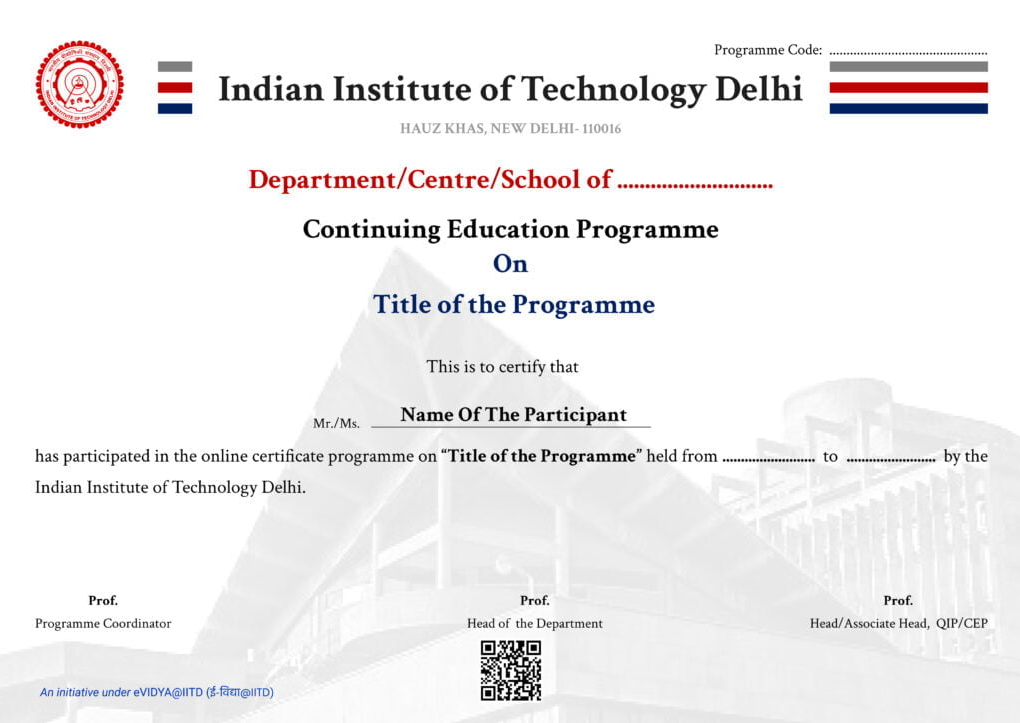
Program Certificate

certificate

Candidates need to secure minimum 50% overall to be eligible for the Certificate of Successful Completion certificate from CEP, IIT Delhi.^Candidates who are not able to secure 50% overall to be eligible for the Certificate of Participation certificate from CEP, IIT Delhi.^The organizing department of this programme is Yardi School of Artificial Intelligence, IIT Delhi.^Only e-certificates will be issued by CEP, IIT Delhi for this programme.

Other programs in this subject area you might find useful

Same topic, Similar duration - Broader exploration across all institutes

Contact us for the further details

Speak with an Advisor

  1. Pedagogy (case method, experiential learning, coaching, simulations)
  2. Programme Objective
  3. Brochure

Prashansa Uttam

Programme Advisor

+91 9403890085contact@echomind.oneMon – Fri, 9am – 5pm IST

Indian Institute of Technology Delhi

Executive Education Office

NA
NA
NA
https://home.iitd.ac.in
New Delhi, India

Tell us about your program enquiry

Fill out the form below and our team will get back to you within 24 hours.

Artificial Intelligence And Machine Learning For Industry | IIT Delhi